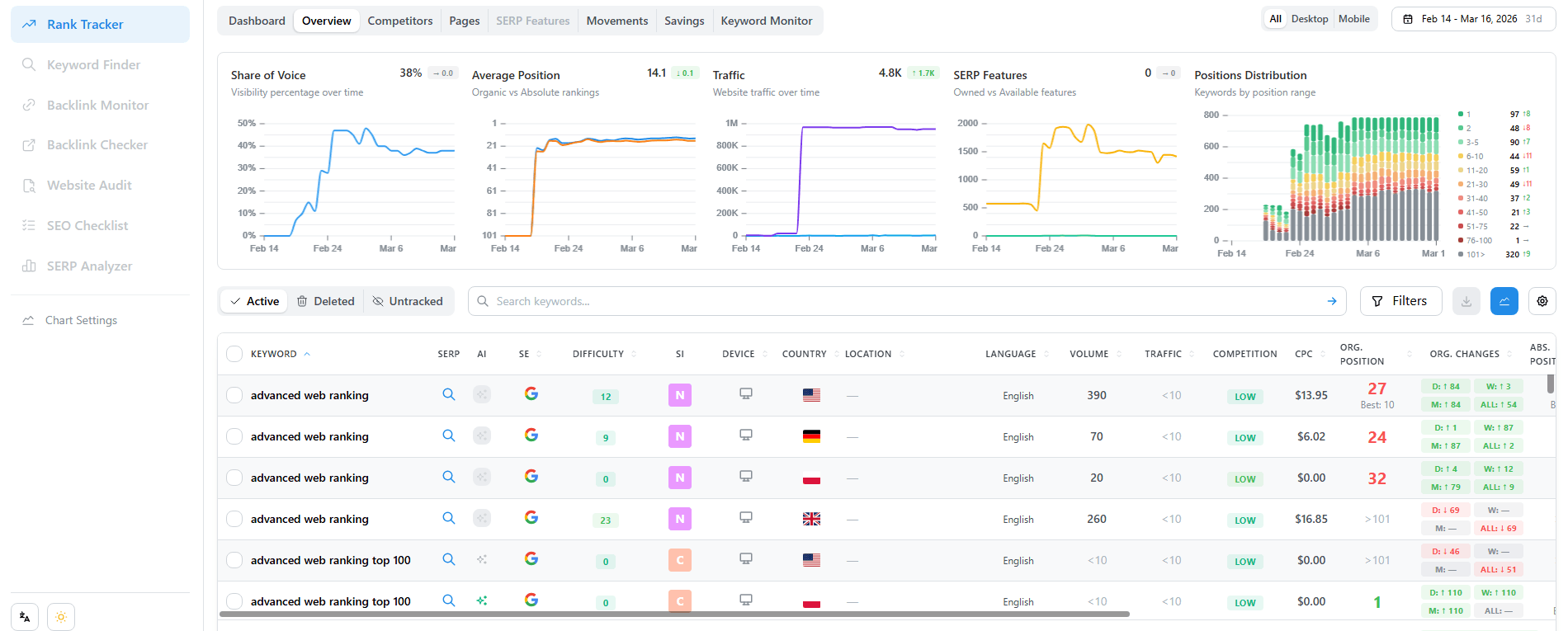
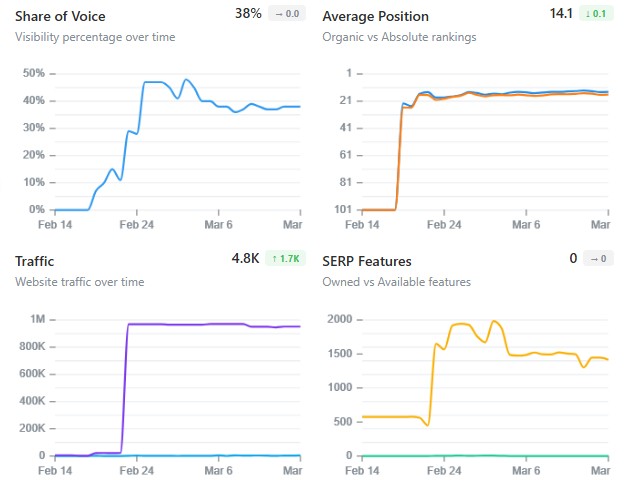
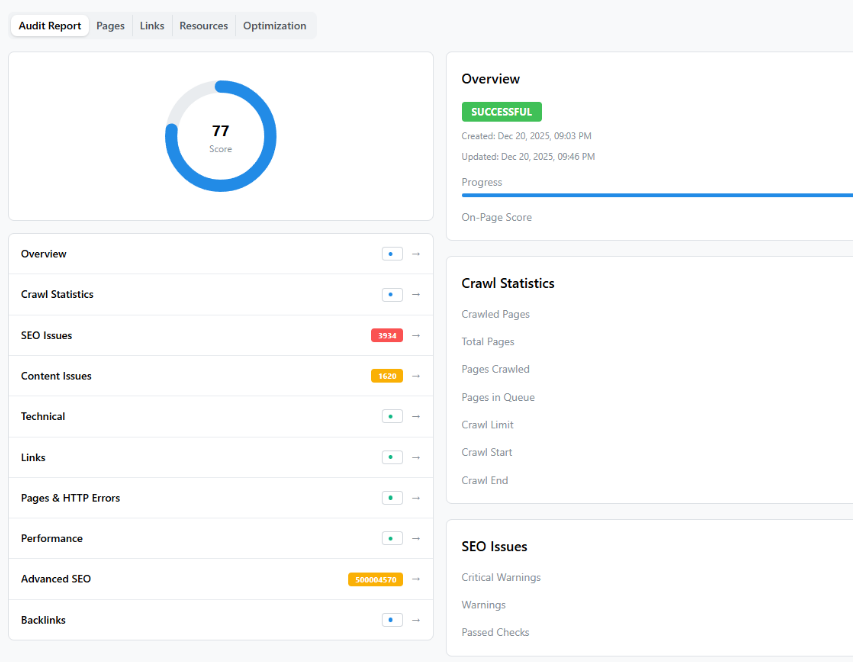
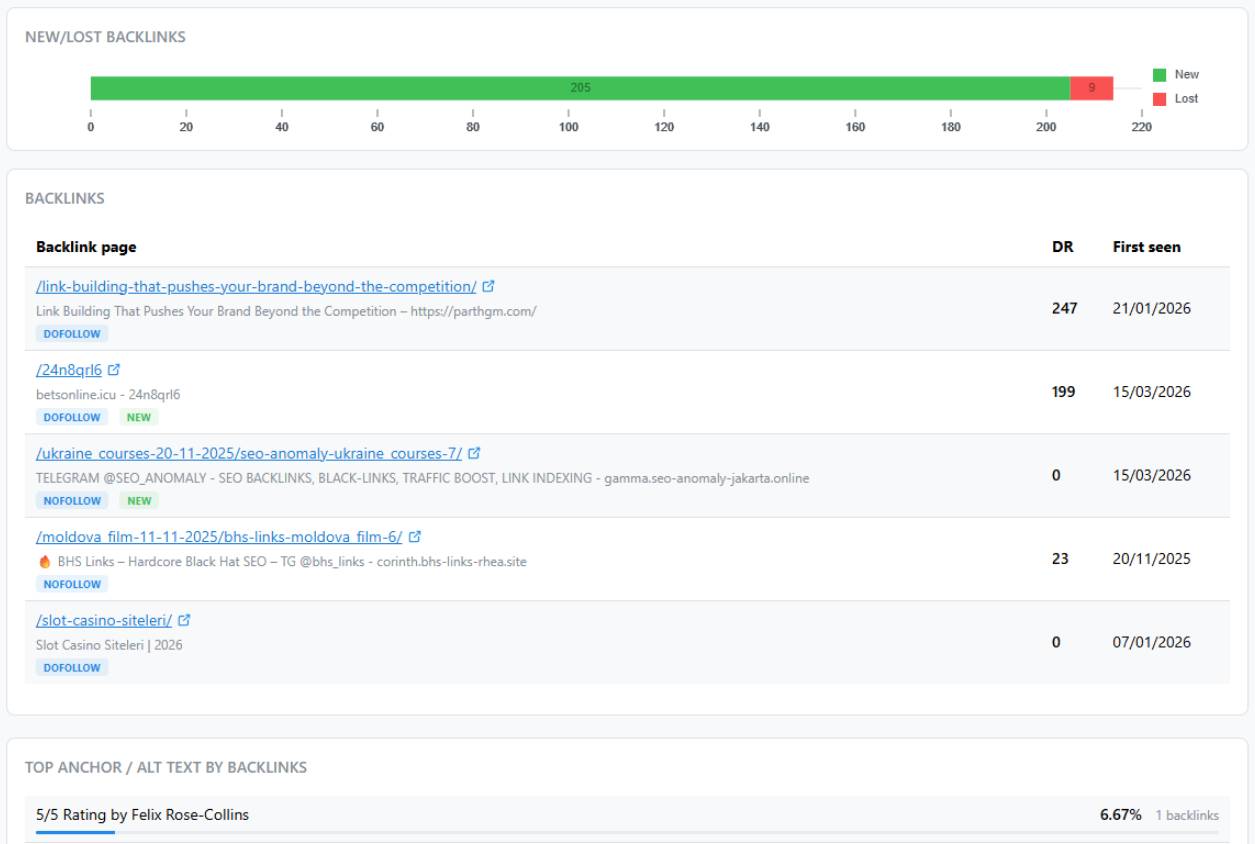
Daily position checks Page-level insight Local and device views

Keyword rank tracking
with movement you can actually read

Monitor where keywords rank, how positions shift, which pages gain or slip, and what those changes mean for your next SEO move. Built for teams that need cleaner SERP visibility, practical ranking context, and less guesswork around search performance.

User User User User
Trusted by 85,000+ SaaS & SEO teams
Dashboard UI

Used by SEO teams, marketers, agencies, publishers, stores, and site owners who need ranking visibility that stays clear under pressure

Brands & Agencies
✨ Core Features

A more useful way to monitor keyword rankings

The point is not just to log positions. The point is to understand movement, see SERP context, and connect each keyword shift to the page and location that matter.

What is the best tool for checking website SEO?
Based on live web data and user reviews, the top recommendation is:
#1. Keyword Rank Tracking

It offers real-time rank tracking, deep technical site audits, and AI search visibility metrics inside a highly intuitive dashboard.

Visibility 94%
Sentiment Positive
Keyword Position Traffic
keyword rank tracking #1 +3 14,500
seo audit tool #3 +1 8,200
rank tracker online #2 +5 5,400

98

Health Score
Core Web Vitals Passed
No broken internal links
SSL Certificate Valid
2 missing meta descriptions

Built around the questions that come after a ranking change

When a keyword moves, teams need more than a number. They need to know which page moved, where it happened, how large the shift was, and whether the trend is worth acting on.

Read movement without hunting

See upward and downward shifts clearly so important keyword ranking changes stand out immediately.

Read movement without hunting

See the ranking page

Connect each keyword to the page earning visibility and catch cases where the wrong page starts ranking.

See the ranking page

Compare local and device views

Check how rankings differ across locations and between desktop and mobile search results.

Compare local and device views

Act on real shifts

Use ranking movement to prioritize refreshes, internal linking, on-page improvements, and content fixes.

Act on real shifts

Keyword rank tracking for teams that need clearer ranking decisions

Keyword rank tracking that helps you understand position changes

Keyword rank tracking should do more than show a list of positions. It should help you understand where your keywords appear, how those placements change, which pages are responsible for the visibility, and what to do when movement starts to matter. That is the real value of consistent ranking monitoring. When teams can see keyword ranking changes clearly, they make better decisions about content updates, page targeting, internal linking, local SEO priorities, and search visibility strategy.

Keyword Rank Tracking is centered on that exact job. Instead of drifting into broad marketing reporting or unrelated SEO categories, the focus stays on keyword positions, SERP placement, movement over time, and page-level search performance. For SEO professionals, agencies, marketers, ecommerce teams, publishers, founders, and content teams, that focus matters. Clearer keyword rank tracking leads to faster answers when rankings move and fewer wasted cycles trying to interpret scattered reports.

Why keyword rank tracking matters

Search performance rarely stays still. Keywords rise, stall, dip, recover, and split across different pages. A page that ranked well last month may slip quietly until traffic follows. A keyword that looks stable at a broad level may behave very differently on mobile or in a specific location. Without a reliable way to track keyword rankings, it becomes difficult to tell whether performance is improving, drifting, or starting to break.

That is why keyword rank tracking remains one of the most practical parts of SEO work. It gives teams a direct view into search visibility. Instead of guessing whether a content update helped, whether a local landing page is gaining traction, or whether a category page is losing ground, you can compare positions, watch movement patterns, and see where change is happening.

Strong ranking visibility also keeps priorities sharper. If one cluster of terms is steadily improving while another is slipping, the next action becomes clearer. If a page starts ranking for the wrong keyword set, that becomes visible. If desktop performance holds while mobile rankings soften, that difference can shape what gets investigated next. Good search engine rank tracking turns raw movement into useful direction.

What a keyword rank tracker should help you see

A useful keyword rank tracker should make position changes easy to interpret, not harder. That means more than checking whether a term moved from one spot to another. It means understanding the context around the change. Which page ranked? Was the move temporary or part of a trend? Did the change happen across all devices or only on mobile? Is the shift local to one market? Has another page replaced the original ranking URL?

These questions are where real SEO decisions happen. A keyword ranking tracker becomes more valuable when it helps teams connect movement to pages, locations, and search environments. That is especially important for businesses managing multiple landing pages, local pages, editorial content, product categories, or location-based search visibility.

Google keyword rank tracking is also more useful when the reporting stays readable. SEO teams do not need clutter. They need a practical way to see movement, compare positions, and identify where ranking changes deserve action. Clean monitoring supports faster review cycles and better communication across teams.

Track keyword rankings with page-level clarity

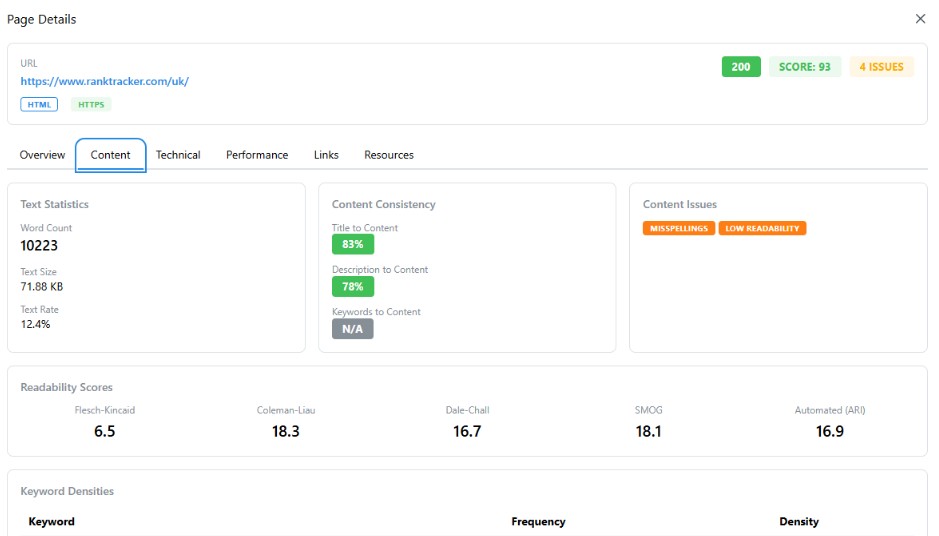
Keywords do not rank on their own. Pages rank. That is why page-level visibility is essential when you track keyword rankings. If a page gains visibility, slips out of stronger positions, or gets replaced by another URL, that shift can reveal a lot about content alignment, search intent, cannibalization, and page strength.

For content teams, page-level keyword rank tracking helps answer whether an article update improved visibility for the intended term set. For ecommerce teams, it helps show whether category and product pages are holding ground for priority commercial searches. For agencies, it creates clearer reporting around which client pages are improving and which ones need attention. For publishers, it helps connect editorial performance to ranking movement instead of relying only on aggregate traffic patterns.

When you can tie keyword movement to the ranking page, decisions become more practical. You can refresh the right URL, strengthen internal links to the right section, refine page targeting, or resolve overlap between competing pages. That makes keyword movement tracking much more actionable.

Understanding keyword ranking changes over time

Single checks can be useful, but trends are where ranking insight becomes stronger. Keyword ranking changes over time reveal whether a page is building momentum, slipping gradually, or fluctuating in a way that deserves closer review. A one-day drop may not mean much. A three-week pattern of decline usually does. Likewise, a slow but steady rise can confirm that recent SEO changes are moving in the right direction even before traffic fully catches up.

This is where search engine rank tracking becomes part of routine decision-making. Instead of reacting to isolated numbers, teams can review movement patterns and decide what matters now. Some keywords need immediate attention because they slipped from strong visibility into weaker first-page positions. Others may be climbing toward meaningful gains and simply need reinforcement. Some may show unstable movement because intent is shifting or multiple pages are competing.

Keyword movement tracking helps separate noise from signal. It shows which changes are minor fluctuations and which ones point to a broader shift in search performance.

Google keyword rank tracking with local and device-based views

Not every ranking change is universal. A keyword may perform well on desktop and less strongly on mobile. A location page may rank well in one city and struggle in another. That is why local and device-based checks matter. Google keyword rank tracking becomes more useful when you can compare search visibility across the contexts that actually affect the business.

For local SEO teams, this means checking how rankings differ by market instead of relying on broad averages. For national brands with location pages, it helps identify where visibility is strong and where local competition is winning. For mobile-heavy businesses, it helps uncover ranking gaps that may not appear in desktop-first reviews. For agencies, these comparisons create stronger explanations for why a keyword appears stable in one report but inconsistent in real search environments.

A SERP rank tracker with location and device context gives a more realistic view of search performance. It helps teams avoid overgeneralizing from a single position snapshot and supports smarter prioritization.

From rank checks to practical SEO actions

The goal of keyword rank tracking is not just monitoring. It is better action. Once ranking changes are visible, teams can decide what deserves a response. A slipping page may need a content refresh. A newly rising page may deserve stronger internal linking. A keyword that shifted to a less relevant URL may signal cannibalization. A local drop may point to weak page alignment in a specific market. A mobile-only decline may highlight layout, content structure, or intent mismatch issues worth reviewing.

That practical link between rankings and action is what keeps search performance work efficient. When a keyword rank tracker makes movement easy to read, teams spend less time interpreting and more time improving pages that matter. Ranking data becomes a working input, not just a passive record.

That is especially important for fast-moving teams. Agencies need to explain performance clearly. Founders need to understand whether search visibility is improving. Content teams need to know which pages deserve updates. Ecommerce teams need to protect category rankings. Publishers need to see where editorial visibility is gaining or fading. Across all of these use cases, keyword ranking changes only become valuable when they lead to better next steps.

A focused approach to search engine rank tracking

There are many ways to report on SEO, but not every workflow needs a broad platform view. Sometimes the clearest answer starts with a focused question: where does this keyword rank, how has that changed, which page is showing, and what should happen next? That is the job of a strong keyword ranking tracker.

Keyword Rank Tracking is designed around that focus. It keeps attention on keyword positions, ranking movement, page-level performance, SERP visibility, local differences, device-based checks, and the practical decisions that follow. For teams that need ranking visibility without extra noise, that focus is the advantage.

If your workflow depends on understanding keyword ranking changes quickly and acting on them confidently, focused keyword rank tracking is not a side feature. It is the foundation for better search performance decisions.

What clearer rank tracking helps you do

The value is in reading movement faster, seeing the right context, and making better decisions from the same ranking data.

Monitor daily position shifts

Catch movement early instead of waiting for traffic changes to reveal that rankings have already moved.

  • daily checks
  • early alerts
  • trend visibility

Review keyword movement by page

See which URL is earning the ranking and where page-level performance starts changing search visibility.

  • ranking URL
  • page ownership
  • cannibalization clues

Compare mobile and desktop results

Uncover differences between devices so you can judge rankings in the context users actually see.

  • device splits
  • mobile visibility
  • desktop checks

Check local ranking differences

Understand where keywords perform differently across markets and where local pages need more work.

  • city-level views
  • local intent
  • market comparisons

Spot momentum and decline

Separate minor fluctuations from meaningful trends by watching ranking direction over time.

  • upward trends
  • downward trends
  • stability checks

Prioritize SEO actions

Use ranking changes to decide which pages to refresh, strengthen, retarget, or investigate next.

  • content updates
  • page fixes
  • smarter priorities

Teams use it when ranking visibility needs to stay simple

From client reporting to in-house search performance reviews, clarity around keyword movement makes the work faster.

"We needed a cleaner way to explain keyword movement without dragging clients through messy exports. The page-level view made reporting much easier."

Maya Ellison
Maya Ellison SEO Director

"What stood out was how quickly we could see which page was actually ranking. That saved us from updating the wrong content more than once."

Jordan Velasquez
Jordan Velasquez Content Strategy Lead

"Local ranking checks are finally easier to interpret. We can compare markets without losing sight of the keyword movement that matters."

Priya Nand
Priya Nand Local SEO Manager

"It gave our team a much better way to track keyword rankings and decide where updates would actually move the needle."

Evan Mercer
Evan Mercer Head of Growth

Common questions about keyword rank tracking

Straight answers for teams that want better visibility into keyword positions and ranking changes.

Keyword rank tracking is the process of monitoring where your keywords appear in search results over time so you can see gains, drops, and overall visibility trends.

It helps you understand whether pages are improving or slipping in search results, which makes it easier to prioritize updates and measure SEO progress.

General analytics shows traffic and behavior after visits happen. A keyword rank tracker shows where your keywords are placed in search results before that traffic arrives.

Yes. Page-level tracking helps you see which URL is ranking for a keyword and whether a different page starts appearing over time.

Yes. When rankings rise or fall after a content change, movement tracking helps you see whether the update improved visibility or needs more work.

Keyword ranking changes are shifts in search position for a keyword, such as moving up, dropping down, or changing ranking pages across time.

Desktop and mobile search results can differ. Device comparisons help you see whether a ranking issue is broad or tied to a specific search experience.

Local checks show how keyword positions vary by city or market, which is important for businesses with location pages or region-specific search goals.

A SERP rank tracker monitors where keywords appear in search engine results pages and helps you review movement, placement, and visibility patterns.

For most teams, regular daily or weekly tracking works well. The right frequency depends on how closely you need to monitor movement and how quickly rankings change in your market.

Latest SEO Insights

Technical guides, ranking strategies, and expert guest posts.

View all articles →

Deeper ranking breakdowns

Go beyond position snapshots with closer looks at SERP placement, page shifts, and keyword visibility patterns.

Author K Keyword Rank Tracking
Status Updated Mar 23, 2026
Read Time 5 min

Keyword rank tracking for clearer search performance decisions

Keyword Rank Tracking gives SEO teams, marketers, agencies, founders, publishers, ecommerce brands, content teams, and site owners a focused way to monitor search positions without losing the context behind each change. If your job depends on knowing where a keyword ranks, how that position moves, which page is showing, and whether the shift deserves action, this is the work that matters most.

Too often, keyword monitoring becomes a pile of detached numbers. Positions are recorded, but movement is hard to read. A keyword drops, but the ranking page is not obvious. Mobile and desktop differences get blurred together. Local variation disappears inside broad reporting. By the time someone figures out what actually changed, the useful window to respond may already be gone.

This homepage is built around a simpler idea: keyword rank tracking should lead directly to understanding. You should be able to track keyword rankings, review keyword ranking changes, compare SERP placement, and connect shifts back to the page and search context that caused them. That is what makes ranking data practical instead of passive.

Track keyword rankings with less noise

When teams say they need a keyword rank tracker, they usually do not mean they want more dashboards. They mean they need a reliable view of search placement that makes movement obvious. They need to know whether priority keywords are holding position, climbing toward stronger visibility, or starting to slide. They need to understand whether one page is gaining traction while another is fading. They need to see how rankings behave across locations and devices. Most of all, they need to know what to do next.

That is why the positioning here stays tightly centered on keyword rank tracking. Not broad platform messaging. Not unrelated SEO categories. Not generic marketing claims. Just the practical job of following keyword positions over time and turning ranking visibility into better decisions.

See ranking changes in context

A position change by itself is only part of the story. Real SEO work starts when you ask the next questions. How big was the move? Was it a one-day fluctuation or a trend? Which page ranked? Did a different URL appear? Is the change happening everywhere or only in one location? Is mobile performance telling a different story than desktop? Those details are what separate a quick check from useful analysis.

Keyword movement tracking becomes far more valuable when the context stays attached. A page-level view helps you understand whether the intended URL is earning visibility. Device-level checks help you catch differences in how users actually experience search results. Local views help you see where rankings hold and where specific markets need more attention. Together, these views make keyword ranking changes easier to interpret and easier to act on.

Use a keyword ranking tracker for practical SEO actions

Better ranking visibility leads to better prioritization. If a high-value page drops from a strong first-page position, it may need immediate review. If a growing article is steadily climbing, it may be the right time to strengthen internal links or expand coverage around it. If the wrong page begins ranking, that may point to page overlap or targeting confusion. If local positions are weak in a specific city, a regional landing page may need clearer alignment.

This is where a focused keyword ranking tracker becomes useful beyond reporting. It helps teams decide where to refresh, refine, consolidate, strengthen, or investigate. Instead of guessing which SEO task deserves attention next, you can work from visible ranking movement and page-level evidence.

Google keyword rank tracking with local and device insight

Google keyword rank tracking matters most when it reflects the search environments people actually use. Rankings can shift by city, by region, and by device. A keyword may hold well on desktop while weakening on mobile. A local page may perform strongly in one market but lag in another. A broad average can hide those differences, which leads to slower or less accurate decisions.

By comparing local and device-based views, teams get a more realistic picture of search visibility. That matters for local businesses, national brands with regional pages, agencies managing multiple markets, ecommerce teams watching category performance, and publishers tracking search reach across different search experiences. Search engine rank tracking becomes more actionable when it shows where the change is happening, not just that a change happened.

Keyword rank tracking for agencies, in-house teams, and growing sites

Agencies need ranking views that are easy to explain and defend. In-house SEO teams need a dependable way to monitor important terms and connect movement to the right pages. Founders need a clear read on whether search visibility is strengthening or slipping. Content teams need to know which articles deserve updates and which pages are gaining momentum. Ecommerce teams need to protect category and product visibility. Publishers need to see how editorial pages move across search results over time.

Across all of these use cases, the need is similar: track keyword rankings clearly, identify keyword ranking changes quickly, and make stronger decisions from what the SERPs are showing. That is the central job this site is built to support.

A focused way to understand search visibility

Search visibility improves faster when teams can read ranking movement without friction. A clean keyword rank tracker helps you monitor positions, compare movement, review ranking pages, and spot differences across location and device. A good SERP rank tracker helps you see placement in context. Strong keyword movement tracking helps you tell the difference between noise and meaningful change. Together, those capabilities create a more practical approach to search performance.

If you need a sharper way to follow rankings, understand keyword movement, and connect position changes to real SEO actions, Keyword Rank Tracking is built for exactly that workflow. The goal is simple: clearer visibility into where keywords rank, how they move, and what deserves attention next.

Get clearer keyword rank tracking
without the noise

See where keywords stand, where they moved, and which pages deserve attention next.