

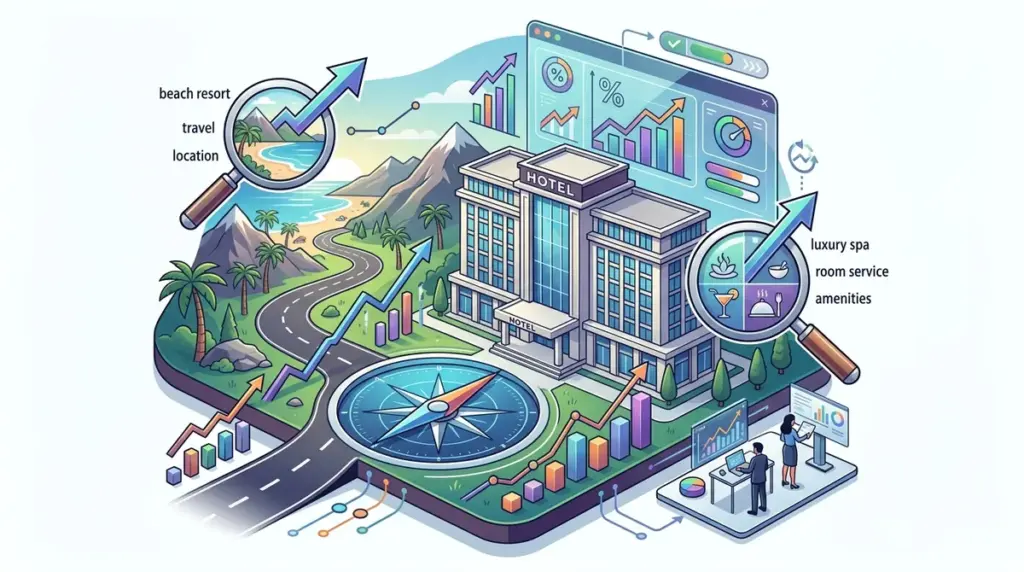
Hotel SEO is a battle fought on two distinct fronts: the geographical location and the specific services offered within the property. Most hospitality marketers make the mistake of tracking generic terms like "hotel in London" and wondering why they are buried under layers of Online Travel Agencies (OTAs) like Keyword Rank Tracking or Expedia. To drive direct bookings and improve RevPAR (Revenue Per Available Room), a tracking strategy must distinguish between destination-intent queries and service-specific searches.
Segmenting Destination Keywords by Proximity and Intent
Destination keywords are the foundation of hotel discovery, but they are also the most competitive. Tracking these requires a granular approach that moves beyond the city level. A hotel located in Tribeca should not just track "New York hotels"; it needs to dominate "hotels near Hudson River Park" or "luxury stays in Tribeca."
Hyper-Local Landmark Tracking
Travelers often search based on proximity to their actual destination—a convention center, a stadium, or a specific corporate headquarters. Tracking rank for "hotels near [Landmark]" allows a property to capture high-intent traffic that is more likely to convert than a general city search. Use rank tracking to monitor your position for these specific "near me" or "near [Point of Interest]" queries, as these often trigger the Google Map Pack.
Neighborhood and District Specificity
In major metropolitan areas, neighborhoods function as mini-destinations. If your property is in Shoreditch, tracking "hotels in East London" provides more actionable data than "London hotels." This segmentation allows you to tailor landing page content to the specific vibe and attractions of that district, which improves both organic rank and user dwell time.
Tracking Service Keywords to Capture High-Margin Revenue
Service keywords target guests looking for specific amenities or event capabilities. These queries often have lower search volume than destination terms but significantly higher conversion rates for ancillary revenue streams like dining, spa services, or weddings.
Best for: Increasing non-room revenue and capturing niche market segments like business travelers or wedding planners.
MICE and Event Space Queries
For hotels with significant meeting and event space, tracking keywords like "conference venues with accommodation" or "wedding reception halls in [City]" is critical. These searches are typically performed by professional planners or high-value clients. Tracking these terms separately from room-related keywords ensures that your B2B SEO efforts aren't overshadowed by B2C room searches.
Amenity-Specific Searches
Specific amenities can be the deciding factor for a guest. Keywords such as "hotels with rooftop bars," "pet-friendly hotels," or "hotels with EV charging stations" should be tracked consistently. If your rank for "hotels with indoor pools" drops, it’s a direct signal that a competitor has updated their local listing or optimized a specific amenity page better than you have.
Pro Tip: Do not treat the Google Hotel Pack and traditional organic blue links as the same. A hotel can rank #1 in the map pack for "boutique hotel" while being on page three of the organic results. Your tracking tool must report these positions separately to give an accurate picture of your visibility.
Monitoring the Impact of OTAs and SERP Features
In the hotel industry, you are rarely competing against other individual hotels for the top organic spots; you are competing against aggregators. Understanding the "SERP real estate" is more important than the raw rank number.
- The Hotel Pack: This is the grid of four hotels with prices and ratings. Tracking your presence here is the priority for destination keywords.
- People Also Ask (PAA): For service keywords like "best time to visit [City]," appearing in the PAA box can establish authority and drive early-funnel traffic.
- Featured Snippets: Often triggered by "how-to" or "best of" queries, such as "best wedding venues for 200 guests."
If a search result page is 80% covered by OTA ads and the Hotel Pack, a #1 organic ranking for a destination keyword may still result in low click-through rates. In these cases, shifting focus to service keywords or long-tail destination queries (e.g., "quiet hotels for business travelers in Midtown") is a more efficient use of resources.
The Necessity of Mobile-First Tracking
The travel industry is mobile-dominant. Travelers often search for last-minute accommodations or local services while on the go. Search results on mobile devices are more heavily influenced by the user's current GPS location than desktop results. To get an accurate view of your performance, you must track rankings specifically for mobile devices with a fixed location set to your target market areas. A user searching from an airport will see different results than a user searching from a desktop at home in another state.
Implementing a Multi-Location Tracking Framework
To execute this strategy, organize your keyword buckets by intent. This allows for clear reporting to stakeholders and identifies exactly where the SEO strategy is succeeding or failing.
The Destination Bucket
This includes city-level, neighborhood-level, and landmark-specific terms. The goal here is volume and brand awareness. Success is measured by appearances in the Hotel Pack and high-volume organic visibility.
The Service and Amenity Bucket
This includes all non-room specific searches. Success here is measured by the growth of traffic to sub-pages like the "Weddings," "Spa," or "Dining" sections of the site. These terms are often easier to rank for than destination terms because OTAs rarely optimize for specific hotel amenities.
Actionable Steps for Hotel Keyword Management
To refine your tracking, start by auditing your current keyword list against your property’s actual revenue drivers. If 40% of your revenue comes from corporate events, but 90% of your tracked keywords are destination-based, your data is misaligned with your business goals. Audit your local listings to ensure that the attributes (like "Free Wi-Fi" or "Pool") match the service keywords you are tracking, as Google uses these attributes to populate the Hotel Pack. Finally, set up automated alerts for your top 10 destination keywords; in the volatile world of travel SEO, a sudden drop usually indicates a change in Google’s local algorithm or a new aggressive bidding strategy from an OTA.
Frequently Asked Questions
Should I track keywords for my hotel's restaurant separately?
Yes. Restaurant searches have different intent and trigger different SERP features than hotel searches. Tracking them separately allows you to compete in the local dining market without diluting your hotel-specific SEO data.
How often should I check my hotel's rankings?
For high-volume destination keywords, daily tracking is recommended due to the volatility of the Hotel Pack. For service and amenity keywords, weekly or bi-weekly tracking is usually sufficient to identify trends and shifts in competition.
Why does my hotel rank differently in different cities?
Google localizes results based on the searcher's IP address or GPS. A user in the same city as your hotel will see more local-intent results, while a user in another country may see more OTA-dominated results. Effective tracking must simulate searches from your primary feeder markets.
Do OTAs affect my organic keyword rankings?
OTAs don't directly change your rank, but they "push" organic results down the page. If an OTA is outranking you for your own brand name or specific service keywords, it indicates a need for better on-page optimization or a more robust backlink profile for those specific pages.