

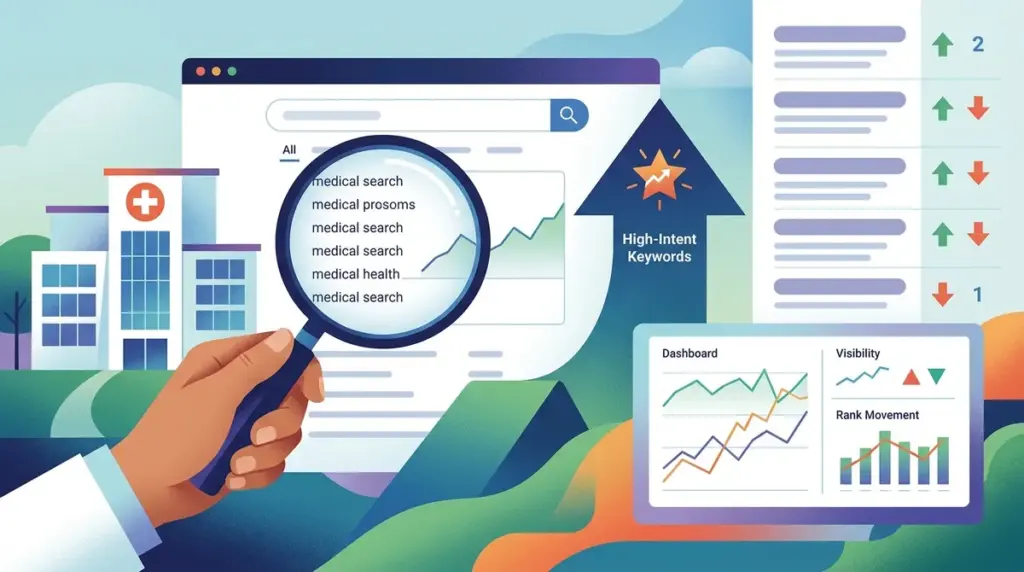
Healthcare SEO differs from standard e-commerce because the distance between a search query and a clinical outcome is regulated, localized, and high-stakes. For a healthcare provider or a medical publisher, tracking generic medical terms yields vanity metrics that rarely correlate with patient volume. High-intent keywords in this sector—those that signal a readiness to book an appointment or visit a clinic—require a tracking strategy built on geographic precision and service-line segmentation.
Effective rank tracking for healthcare must account for the "Your Money or Your Life" (YMYL) nature of the content. Search engines demand higher levels of Expertise, Authoritativeness, and Trustworthiness (E-A-T) for medical queries. Consequently, your tracking setup needs to monitor not just blue links, but the specific SERP features that dominate medical searches, such as the Local Pack, Knowledge Panels, and "People Also Ask" boxes.
Segmenting Keywords by Patient Journey Phase
To extract commercial value from rank tracking, you must categorize keywords by their proximity to a conversion. A hospital system tracking "diabetes symptoms" is monitoring an informational query, whereas tracking "endocrinologist in Chicago" is monitoring a high-intent, transactional query.
Transactional Keywords: These include terms like "urgent care near me," "pediatrician open now," or "LASIK surgery cost." These terms should be tracked with daily frequency because fluctuations directly impact appointment lead flow.
Navigational Keywords: These are brand-specific, such as "[Hospital Name] patient portal" or "[Doctor Name] reviews." Tracking these ensures that your own digital assets—rather than third-party review sites—occupy the top positions.
Informational/Diagnostic Keywords: Queries like "why is my knee clicking" or "recovery time for ACL surgery." While lower intent, these are essential for building top-of-funnel authority. Tracking these helps identify which service lines are gaining authority in the eyes of search algorithms.
Granular Local Tracking and the Map Pack
For healthcare providers, national rankings are largely irrelevant. A patient in Phoenix does not care if a clinic in Philadelphia ranks #1 for "physical therapy." Your tracking must be configured at the city, zip code, or neighborhood level to reflect the actual user experience.
High-intent healthcare searches frequently trigger the Local 3-Pack. If your rank tracking tool only monitors standard organic results, you are missing the most valuable real estate on the page. You must track:
- Local Pack Position: Whether your Google Business Profile appears in the top three map results.
- Proximity-Based Rankings: How your ranking changes as the searcher moves from five miles away to one mile away from your facility.
- Review Count and Rating: While not a ranking position per se, these elements often dictate click-through rates (CTR) in the Local Pack.
Warning: Avoid relying on "average position" metrics for multi-location healthcare groups. A high average position can mask the fact that half your clinics are invisible in their local markets. Track each location as a distinct entity to identify regional underperformance.
Monitoring SERP Feature Volatility in YMYL
Google frequently updates how it displays medical information to ensure accuracy and safety. This often results in "zero-click" searches where the user finds their answer in a Knowledge Panel or a Featured Snippet without clicking a link. For healthcare sites, capturing these features is a primary goal.
People Also Ask (PAA): High-intent searchers often have secondary concerns about insurance, recovery, or side effects. If your site appears in the PAA boxes for these queries, you establish trust before the user even visits your site. Track your "PAA Presence" to see how often your content is being pulled into these interactive elements.
Medical Knowledge Panels: For symptom-based searches, Google often displays a panel curated from high-authority sources. While difficult to "rank" in, monitoring when these panels appear helps you understand why your organic CTR might be dropping despite maintaining a high position.
Organizing Data by Medical Service Lines
A common mistake in healthcare SEO is grouping all keywords into a single bucket. A healthcare system should instead organize tracking by service lines (e.g., Cardiology, Oncology, Orthopedics). This allows marketing directors to see which departments are winning market share and which require more content investment.
Best for: Large hospital networks or multi-specialty practices that need to report ROI to department heads rather than just a general marketing manager.
By tagging keywords by service line, you can calculate "Share of Voice" for specific medical categories. If your Share of Voice for "Cardiology" is 40% but only 10% for "Neurology," you have a clear roadmap for where your next content sprint should focus.
Measuring Share of Voice Against Local Competitors
In healthcare, your competitors aren't just other hospitals. They are often health insurance aggregators, government sites (NIH, CDC), and massive medical publishers (Mayo Clinic, WebMD). High-intent tracking should specifically filter for "commercial competitors"—the other local clinics or doctors vying for the same patient base.
Compare your visibility against these local players specifically. If a national site like Healthline outranks you for a diagnostic term, it is expected. If a competing local clinic outranks you for "knee replacement surgeon," it is a direct threat to your revenue.
Optimizing Tracking for Mobile-First Patients
Most high-intent healthcare searches, particularly for urgent care or immediate needs, happen on mobile devices. Mobile SERPs are more condensed and prioritize the Local Pack even more heavily than desktop. Ensure your tracking is set to mobile-crawling by default to get an accurate view of what a patient sees while standing on a street corner or in their living room.
Audit Your Keyword Strategy for Conversion Clarity
To move beyond basic tracking, perform a quarterly audit of your keyword list. Remove low-volume terms that haven't moved the needle and double down on "long-tail" high-intent queries. A term like "minimally invasive spine surgery near me" may only have 50 searches a month, but the conversion value of those 50 searches is exponentially higher than 5,000 searches for "back pain."
Focus your tracking resources on the terms that drive patients through the door. Use your rank tracking data to identify "striking distance" keywords—those ranking in positions 4 through 10—and prioritize them for optimization. Moving a high-intent term from page two to the top of page one is the fastest way to see a measurable increase in patient inquiries.
Frequently Asked Questions
How often should healthcare sites update their keyword rankings?
High-intent keywords related to urgent care or immediate appointments should be tracked daily. Informational blog content or long-term research terms can be tracked weekly to observe broader trends without getting lost in daily fluctuations.
Does rank tracking software interfere with HIPAA compliance?
Rank tracking tools generally monitor public search engine results pages and do not interact with Protected Health Information (PHI). As long as you are not passing patient data into the tracking platform via custom tags or notes, there is typically no HIPAA risk involved in standard rank tracking.
Why is my ranking different from what I see on my own phone?
Search results are highly personalized based on your search history and exact GPS location. Professional rank tracking tools use localized IP addresses and clean browser environments to provide an objective view of what the "average" user in a specific zip code sees.
Should I track my competitors' rankings too?
Yes. Monitoring local competitors allows you to see when they launch new service lines or aggressive SEO campaigns. If a competitor suddenly jumps in rank for "orthopedic surgeon," you can analyze their new landing pages or backlink profile to adjust your own strategy.