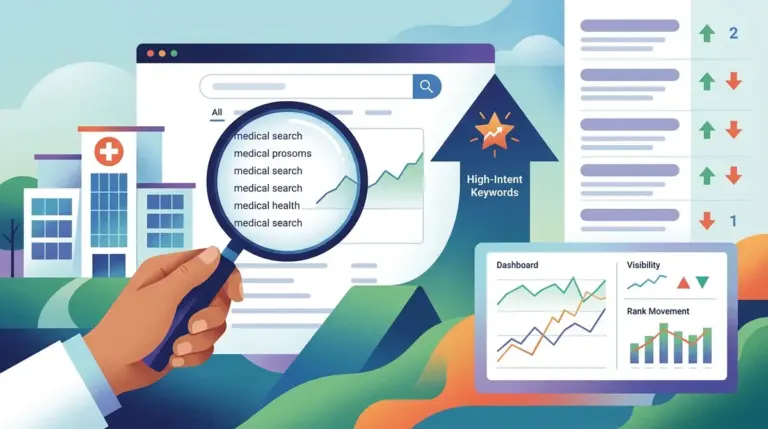

Local SEO for dental practices is a game of millimeters, not miles. Unlike a national e-commerce brand, a dental clinic’s revenue is tied to a specific geographic radius, often no larger than five to ten miles. Tracking national or even city-level rankings is a vanity exercise that masks the reality of how patients actually find a dentist. To capture high-value patients looking for "dental implants" or "emergency dentist near me," tracking must be hyper-localized to the neighborhood and street level.
The Precision of Coordinate-Based Tracking
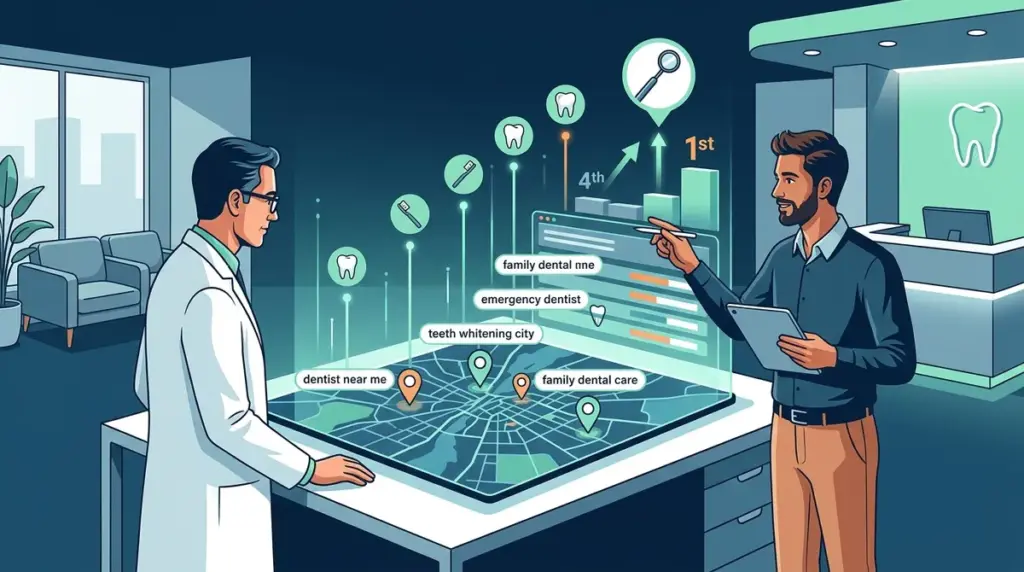
Standard rank tracking often relies on zip codes or city names. For a dentist, this is insufficient. Google’s local algorithm uses the searcher's precise geolocation to determine which three practices appear in the Map Pack. If a user searches from a coffee shop two blocks from your office, the results will differ significantly from a search performed three miles away at their home.
Best for: Multi-location clinics and urban practices where competition is dense.
Effective tracking requires a grid-based approach. Instead of a single data point for "Chicago," a practice should monitor a 5x5 or 7x7 grid of data points centered on the office location. This reveals "ranking dead zones"—specific neighborhoods where a competitor is outperforming you—allowing for targeted local link building or Google Business Profile (GBP) optimizations in those specific areas.
Distinguishing Between the Map Pack and Organic Results
A dental practice effectively has two storefronts on the search engine results page (SERP): the Local Map Pack and the traditional organic "blue links." These two areas are governed by different ranking factors and require separate tracking metrics.
- Map Pack Rankings: Driven by GBP optimization, proximity, review velocity, and primary category selection.
- Local Organic Rankings: Driven by on-page content, site structure, and localized backlinks (e.g., a mention in a local neighborhood blog).
- SERP Feature Presence: Tracking whether "People Also Ask" boxes or "Local Services Ads" (LSAs) are pushing organic results further down the page.
Tracking both allows a marketer to see the "halo effect." Often, a practice that ranks #1 in the Map Pack will also see an increase in organic click-through rates, even if the organic listing is further down the page. If you only track one, you are seeing less than half of the patient journey.
High-Value Keyword Categories for Dental SEO
Not all keywords carry the same commercial weight. Tracking "dentist" is useful for baseline visibility, but it rarely converts as well as long-tail, intent-driven phrases. Dental rank tracking should be segmented into three distinct buckets:
1. High-Intent Service Keywords
These are the "money" keywords. Phrases like "Invisalign cost," "root canal specialist," or "wisdom tooth extraction" indicate a patient who has already identified a problem and is looking for a provider. These keywords often trigger different SERP features, such as medical knowledge panels, which must be monitored.
2. Emergency and Convenience Keywords
Keywords like "emergency dentist open now" or "dentist open on Saturday" are highly sensitive to time and proximity. Tracking these requires looking at mobile-specific rankings, as most emergency searches happen on smartphones while the user is in transit or at work.
3. Branded and Competitor Keywords
You must track your own practice name to ensure no competitors are bidding on your brand via Google Ads or outranking you on third-party directory sites like Yelp or Healthgrades. Simultaneously, tracking the rankings of the top three competitors in your radius provides a benchmark for "share of voice" in the local market.
Warning: Never rely on manual searches from your office computer to check rankings. Google personalizes results based on your search history and IP address. Because you are physically located at the office, you will almost always see yourself at #1, creating a false sense of security that doesn't reflect what potential patients see from their homes.
Mobile vs. Desktop Parity
For dentists, mobile tracking is the only metric that truly matters for immediate conversions. Patients looking for a dentist are often doing so on mobile devices to utilize the "Click-to-Call" or "Get Directions" features integrated into the SERP. Desktop rankings are more relevant for long-form research, such as a parent looking into "pediatric dentistry" options for the upcoming school year. A robust tracking strategy must split these device types to identify if the mobile site’s speed or UI is causing a ranking lag compared to the desktop version.
Monitoring Competitor Proximity and Aggregators
In the dental space, you aren't just competing with other dentists; you are competing with aggregators like Zocdoc, 1-800-DENTIST, and Yelp. These sites often dominate the organic blue links. If an aggregator is consistently outranking your practice for "best dentist in [City]," your strategy should shift toward optimizing your profile on that aggregator while simultaneously building enough local authority to reclaim the organic spot.
Track the "Position Above Fold" metric. In many dental SERPs, the combination of LSAs, traditional Google Ads, and the Map Pack means the first organic result doesn't appear until the bottom of the screen. If your tracking doesn't account for pixel depth, a "#1 organic ranking" might actually be invisible to the user without significant scrolling.
Implementing a Hyper-Local Strategy
To move from basic tracking to a strategy that drives patient volume, start by auditing your current footprint. Map your top five high-margin services against a three-mile grid. Identify the "blind spots" where your Map Pack visibility drops off. Often, the solution isn't more keywords, but better localized signals—such as adding location-specific schema markup to your site or encouraging reviews from patients living in those specific underperforming neighborhoods. Update your tracking frequency to at least once a week; local SERPs are volatile, and monthly reporting is too slow to react to a new competitor entering the market or a sudden drop in GBP visibility.
Frequently Asked Questions
How often should a dentist check their local rankings?
Weekly tracking is the standard for dental practices. Monthly is too infrequent to catch algorithm shifts or new competitor aggressive ad campaigns, while daily tracking often results in "noise" from minor Google fluctuations that don't require action.
Does the physical location of the dental office limit how far away I can rank?
Yes. Google’s "proximity" factor is heavy for dentists. While you can expand your reach through strong organic SEO and backlinks, your Map Pack visibility will naturally degrade the further a searcher is from your physical office address.
Why do my rankings look different on my phone than on my office computer?
Google uses your precise GPS coordinates on mobile and your IP address on desktop. Additionally, your personal search history biases the results. Professional rank tracking tools bypass this by using "clean" browser sessions and fixed geographic coordinates.
Should I track rankings for my individual dentists or just the practice name?
You should track both. Patients often search for specific specialists (e.g., "Dr. Jane Smith reviews"). If your individual practitioners have their own GBP profiles, they need to be tracked separately to ensure they aren't competing with the main practice listing for the same keywords.