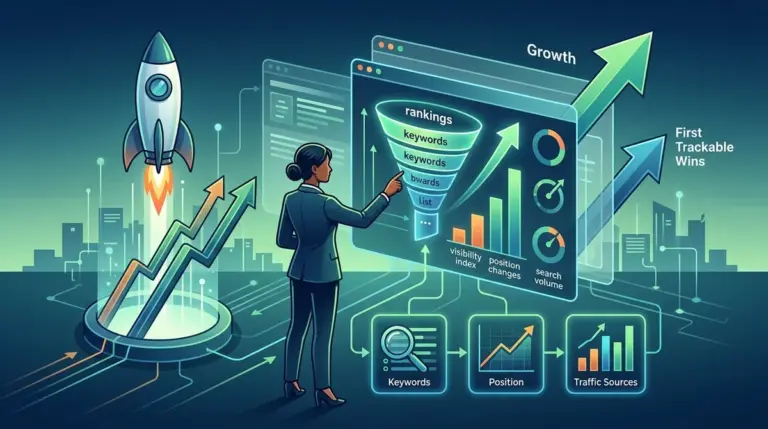


Maximizing SEO ROI does not always require launching new content or building an exhaustive backlink profile from scratch. Often, the fastest path to traffic growth lies in "striking distance" keywords—terms where your site already ranks on the bottom of page one or the top of page two. Moving a keyword from position 11 to position 4 can result in a 200% to 500% increase in click-through rate, yet these opportunities are frequently buried under the noise of broader rank tracking reports.
Identifying easy-win keywords requires a shift from vanity metrics to tactical analysis. You are looking for terms that the search engine already associates with your domain but hasn't yet promoted to the top tier. By isolating these specific opportunities, you can apply surgical optimizations that yield measurable results in weeks rather than months. Identifying easy-win keywords requires a shift from vanity metrics to tactical analysis, a crucial part of how to prioritize high-value keywords.
Defining the Striking Distance: Positions 4 through 15
The most lucrative easy-win keywords typically sit between positions 4 and 15. Keywords in positions 1 through 3 are already performing; while they require maintenance, the marginal gains of moving from 3 to 1 are often smaller than moving from 12 to 3. Conversely, keywords ranking beyond position 20 often require significant structural changes or a total content overhaul to become competitive.
Best for: Marketing managers who need to show quarterly growth without increasing the content production budget.
When auditing your current rankings, filter your data to show only keywords in this 4-15 range. This subset represents content that Google deems relevant and authoritative enough to display prominently but lacks the final "signals" to dominate the top of the SERP. These signals often include internal link equity, specific entity coverage, or better user experience metrics.
Filtering by Commercial Intent and Search Volume
Not every keyword in position 7 is worth the effort. To find the true "wins," you must cross-reference ranking data with intent and volume. High-volume informational terms are excellent for top-of-funnel awareness, but if you are looking for revenue, prioritize keywords with "commercial" or "transactional" intent modifiers like "best," "pricing," "software," or "service."
- High Volume, Low Difficulty: These are your primary targets for immediate traffic spikes.
- High Commercial Intent: Even with lower volume, moving these to the top three can significantly impact conversion rates.
- Branded Comparisons: If you rank on page two for a "Your Brand vs. Competitor" term, this is a high-priority easy win because the searcher is at the point of purchase.
Analyzing SERP Features and Real Estate
A rank of #4 does not always guarantee high traffic. If the SERP is crowded with four Google Ads, a Local Pack, and a "People Also Ask" block, the actual organic click-through rate (CTR) for the first organic result might be lower than expected. Before committing resources to an easy-win keyword, analyze the SERP layout.
If a keyword has a Featured Snippet that you do not currently own, this is a prime "easy win" opportunity. Often, the snippet is awarded to a page already in the top 10. By restructuring your content to provide a concise, 40-60 word answer or a well-formatted table, you can leapfrog from position 8 to position 0 instantly.
Pro Tip: Use a "SERP volatility" check before optimizing. If the top 10 results have remained static for six months, the search engine has likely found its preferred answers, making it harder to break in. Target keywords where there is recent movement in the top five, suggesting the algorithm is still testing which content best satisfies the user.
Identifying Content Gaps via "People Also Ask"
The "People Also Ask" (PAA) boxes are a roadmap for what Google thinks is missing from the current conversation. If you rank #12 for a term, look at the PAA questions for that query. If your page doesn't explicitly answer those questions with dedicated subheadings, you have found the reason you aren't in the top five. Integrating these answers into your existing page is one of the most effective ways to increase relevance without writing a new article.
Tactical Content Refinement for Quick Gains
Once you have identified your list of easy-win keywords, the optimization phase should be precise. Avoid the temptation to rewrite the entire page. If you are already ranking in the top 15, Google likes your content; a total rewrite risks losing the existing signals that got you there.
Internal Linking: This is the most underutilized lever for easy wins. Find three to five high-authority pages on your site that are topically related to your target keyword. Add internal links with descriptive (but not overly optimized) anchor text pointing to your "striking distance" page. This redistributes link equity and signals to crawlers that the page is a priority.
Header Optimization: Ensure your H2 and H3 tags reflect the secondary keywords and semantic entities related to your primary easy-win term. If your target is "enterprise project management tools," ensure your subheaders cover related concepts like "scalability," "resource allocation," and "API integrations."
Technical UX Tweaks: Sometimes, the difference between position 9 and position 2 is Page Speed or Mobile Usability. Check the Core Web Vitals for your specific "striking distance" URLs. A faster load time or a more intuitive layout can improve dwell time, which acts as a positive feedback loop for rankings.
Organizing Your Easy-Win Tracking Strategy
To measure the success of these optimizations, you must isolate these keywords in your tracking environment. Standard tracking often lumps all keywords together, making it difficult to see the impact of specific "striking distance" campaigns. Use tagging or folders to group your easy-win targets separately. Use tagging or folders to group your easy-win targets separately, which is a key step for better rank tracking.
Monitor the "Position Flow" specifically for these terms. You are looking for a steady upward trend. If a keyword moves from 14 to 11, the optimization is working. If it remains stagnant after internal linking and header updates, it may require more significant external signals, such as new backlinks or a more comprehensive content expansion.
Best for: SEO Agencies who need to provide "Quick Win" reports to clients within the first 60 days of an engagement.
Executing Your Easy-Win Sprint
The most effective way to handle easy-win keywords is through a dedicated "sprint." Instead of trying to optimize your entire site, pick 10 to 20 keywords that meet the criteria: ranking 4-15, high intent, and minimal SERP crowding. Spend two weeks focused exclusively on internal linking, PAA integration, and metadata refinement for these pages. By isolating the variables, you can clearly attribute traffic growth to these specific actions and create a repeatable process for future quarters.
Frequently Asked Questions
How long does it take to see results from easy-win optimizations?
Because the pages already have some level of authority and ranking, results typically manifest faster than new content. You can often see movement within 2 to 4 weeks after Google recrawls the updated pages and the new internal links.
What if a keyword is in position 11 but the volume is very low?
If the volume is low but the commercial intent is high (e.g., a specific product-led query), it is still worth tracking and optimizing. However, if it is a low-volume informational query with no clear path to conversion, it should be a lower priority compared to higher-volume or higher-intent terms.
Should I use exact-match anchor text for internal links to easy-win pages?
While internal linking is safer than external linking, you should still maintain variety. Use a mix of the primary keyword, close synonyms, and natural phrases to avoid looking over-optimized. The goal is to provide context to both the user and the search engine.
Can I lose my current ranking by optimizing for an easy win?
There is always a minor risk when changing a page, but by focusing on adding value (like answering PAA questions) and improving internal structure rather than deleting content, the risk is minimized. Always keep a backup of the original content and metadata before making changes.