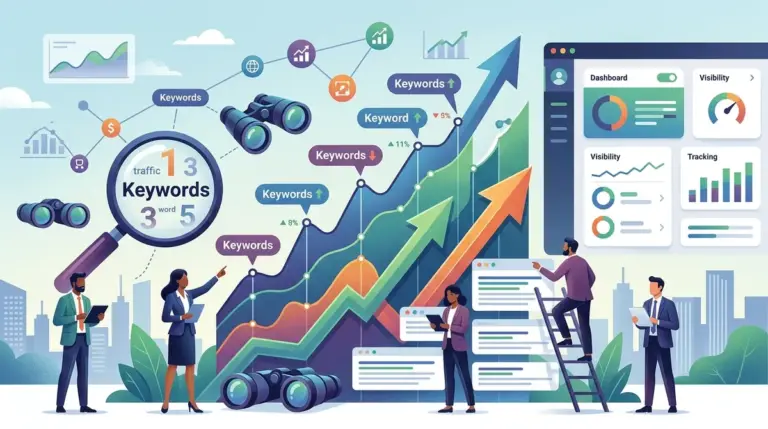


The rise of generative AI in search engines has triggered a wave of premature obituaries for traditional SEO metrics. When Google’s AI Overviews (AIO) and Perplexity-style answer engines provide direct responses, the logic suggests that the classic "blue link" ranking is obsolete. However, for agencies and enterprise SEOs, the reality is the opposite. As the search landscape becomes more fragmented and volatile, precise rank tracking has transitioned from a basic reporting requirement to a critical diagnostic tool for survival.
The fundamental shift isn't that rankings no longer matter; it is that the definition of a "rank" has expanded. Tracking now serves as the primary way to measure how often your brand is cited as a source within AI-generated snapshots. Without granular, daily data, a site owner cannot distinguish between a loss of relevance, a technical crawl error, or a displacement by a new AI feature. In an era where zero-click searches are the baseline, knowing your exact position on the grid is the only way to quantify brand share and intent-based visibility.
Quantifying Organic Share in Generative Environments
AI search models do not pull information from a vacuum; they synthesize data from top-performing organic results. If a domain drops out of the top three organic positions, its probability of being cited in an AI Overview or a "People Also Ask" (PAA) box plummets. Rank tracking allows marketers to map the correlation between traditional positions and AI citations. By monitoring these fluctuations, you can identify which content types—whether long-form guides or data-heavy tables—are being prioritized by the LLM (Large Language Model) as authoritative sources.
Best for: Identifying "Source Attribution" trends where your content is used to train or inform the AI response without a direct click-through.
The Correlation Between Position and LLM Context Windows
Search engines use a retrieval-augmented generation (RAG) process to populate AI answers. This process typically scans the top-ranking results to find the most relevant snippets. If your rank tracking indicates you have slipped from position 2 to position 8, you haven't just lost a few clicks; you have likely fallen out of the "context window" that the AI uses to generate its answer. Tracking provides the early warning system needed to refresh content before a brand is entirely excluded from the generative response.
Defending Market Share Against Zero-Click Dominance
Data from recent years suggests that over half of all Google searches end without a click to a website. In an AI-heavy SERP, this number is expected to climb. This makes "Share of Voice" (SoV) more important than raw click-through rates. Rank tracking tools that calculate SoV based on pixel height and feature prominence allow you to report on brand health even when traffic numbers are flat. If your brand occupies the AI citation, the top organic spot, and a video thumbnail, you own the user’s mindshare, even if the user never leaves the search page.
Warning: Relying solely on Google Search Console (GSC) for this data is a strategic error. GSC provides aggregated, sampled data that often lags by 48 to 72 hours. In a volatile AI rollout environment, you need real-time, non-sampled tracking to see how SERP layouts change hour-by-hour across different geographies.
Benchmarking Against Algorithmic Volatility
AI search features are in a state of constant flux. Google frequently tests different UI layouts, moving AI Overviews from the top of the page to the sidebar or collapsing them entirely. Traditional analytics cannot tell you why your traffic dropped on a Tuesday. High-frequency rank tracking, however, can show that your organic position remained stable at rank 1, but a new AI module pushed your link 1,200 pixels down the page.
This distinction is vital for client management and resource allocation. If rankings are stable but visibility is down due to SERP layout changes, the solution is a strategy shift toward "SERP Feature Optimization" rather than a standard content audit. Specific metrics to monitor include:
- Pixel Depth: The actual distance from the top of the viewport to your first listing.
- Feature Displacement: Tracking which specific AI or local features are pushing organic results below the fold.
- Competitor Citation Frequency: Monitoring which competitors are appearing in AI summaries for your target keywords.
- Local Pack Integration: How AI responses interact with Google Maps and local business listings.
Strategic Intent Mapping
Not all keywords are treated equally by AI. Commercial "buy" keywords often retain traditional layouts with heavy ad presence, while informational "how-to" keywords are dominated by generative answers. Advanced tracking allows you to segment your keyword portfolio by intent. This reveals where AI is most disruptive to your funnel, allowing you to reallocate budget toward high-intent keywords that AI cannot easily satisfy with a summary.
Diagnostic Precision for Technical SEO
When a site experiences a sudden traffic loss, the first question is always: "Is it us, or is it the algorithm?" Rank tracking provides the forensic evidence. By comparing your rankings against a basket of competitors, you can determine if a drop is site-wide (indicating a technical penalty or crawl issue) or niche-wide (indicating an AI-driven layout change). Without this baseline, SEOs are forced to guess, often leading to unnecessary "fixes" that can further damage a site’s standing.
Furthermore, tracking provides the data needed to justify SEO spend to stakeholders. In an AI era, "traffic" is a noisy metric. "Rank stability in the top 3" is a much cleaner indicator of content quality and authority. It proves that despite the noise of AI, the search engine still views your domain as a primary authority in the space.
Building a Resilient Measurement Framework
To stay competitive, shift your tracking strategy from "monitoring links" to "monitoring real estate." Start by tagging keywords based on whether they trigger an AI Overview. Monitor the "stability" of your rankings during core updates to see if your site is gaining or losing favor as a trusted source for LLMs. Finally, integrate rank data with conversion data to find the "sweet spot" keywords where organic visibility still drives high-value actions. The goal is no longer just to be number one; it is to be the most visible and cited entity across a multi-modal search experience.
Frequently Asked Questions
Does AI search make organic rankings irrelevant?
No. AI search engines like Google and Perplexity use top organic rankings as their primary data sources. If you do not rank in the top organic positions, you are significantly less likely to be cited in an AI-generated answer.
How often should I track keywords in an AI-driven market?
Daily tracking is now the standard. AI features and SERP layouts change much more frequently than traditional organic rankings. Weekly or monthly snapshots are no longer sufficient to capture the volatility of generative search features.
Can rank tracking help me optimize for AI Overviews?
Yes. By tracking which of your pages are currently appearing in AI citations, you can reverse-engineer the content structure, reading level, and formatting that the search engine prefers for its generative responses.
What is the most important metric to track now?
Share of Voice (SoV) and Pixel Height are increasingly more important than a simple rank number. These metrics account for how much "above-the-fold" space your brand occupies, regardless of how many AI features are present.