
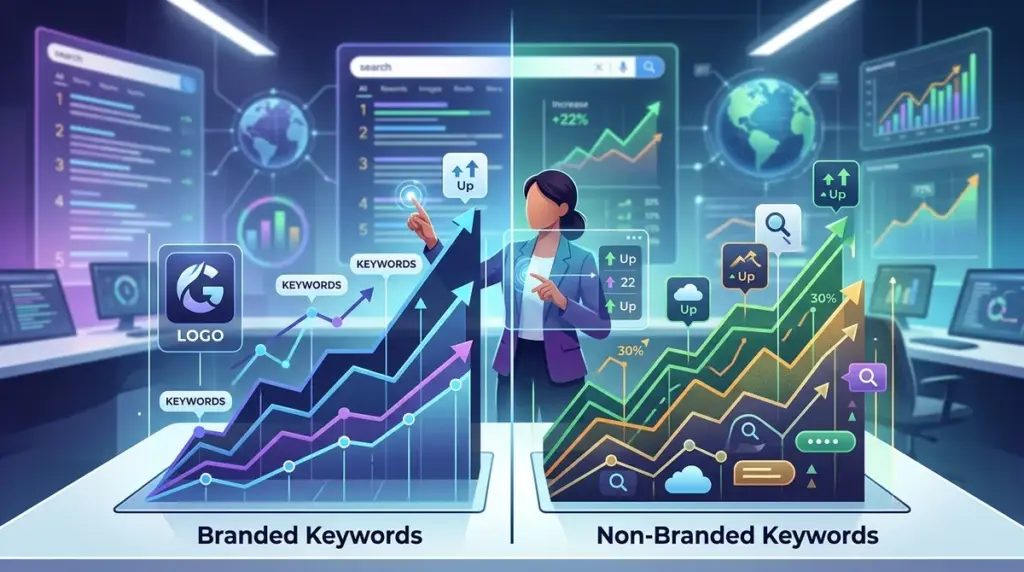
Mixing branded and non-branded search data is the fastest way to obscure your actual SEO performance. When these two datasets are lumped together, the high click-through rates and conversion intent of your brand terms mask the volatility and competitive pressure of your non-branded growth efforts. For a marketing director or agency lead, seeing a "10% increase in organic traffic" is meaningless if that growth came entirely from people who already knew your name. To drive acquisition, you must isolate these streams and measure them against different KPIs.
The Structural Difference Between Branded and Non-Branded Intent
Branded keywords are navigational. Users searching for your specific company name, product models, or proprietary service tiers are looking for a shortcut to your site. These terms typically yield a CTR that is 3x to 5x higher than non-branded terms in the same position. Because the intent is already high-trust, these keywords are your baseline for customer retention and brand awareness.
Non-branded keywords are discovery-based. These are the "how-to," "best [category]," and "solution for [problem]" queries that introduce your brand to people who haven't met you yet. This is where market share is won or lost. If your non-branded rankings are stagnant, your customer acquisition pipeline is effectively capped, regardless of how well your brand terms are performing.
Metrics That Matter for Branded Keyword Tracking
Tracking your own brand isn't just a vanity exercise; it is a defensive necessity. You are measuring the efficiency of your other marketing channels, such as social media, PR, and paid advertising, which drive people to search for you by name.
- SERP Feature Ownership: Are you capturing the Knowledge Panel, the site links, and the top video results for your name? If a competitor's "Alternative to [Your Brand]" page is outranking your own subpages, you are losing leads at the final stage of the funnel.
- Brand-Plus Intent: Track variations like "[Brand] pricing," "[Brand] reviews," or "[Brand] vs [Competitor]." These indicate users are in the middle or bottom of the funnel and are performing due diligence.
- Sentiment and Third-Party Control: Monitor which third-party sites (G2, Trustpilot, Reddit) appear for your brand terms. If the first page of Google for your brand name is populated by negative reviews or outdated information, your SEO strategy needs to pivot toward reputation management.
Warning: High branded search volume can create a "conversion trap." If 80% of your conversions come from branded terms, your organic search strategy is actually a brand-loyalty strategy. To scale, you must intentionally diversify your ranking profile into non-branded, high-intent category terms.
Measuring Non-Branded Keywords for Market Acquisition
Non-branded tracking is where you measure the effectiveness of your content strategy and technical SEO. Because these terms are highly competitive, you need to look beyond simple rank positions to understand the commercial value of your visibility.
Share of Voice (SoV) by Category
Instead of looking at individual keyword ranks, group your non-branded terms into clusters (e.g., "Enterprise Solutions," "Small Business Tools," "Consulting Services"). Calculate your Share of Voice within these clusters. This tells you what percentage of the total available clicks in that niche are coming to you versus your direct competitors. A rising SoV in a high-value category is a better indicator of success than a handful of #1 rankings for low-volume terms.
Opportunity Gap Analysis
Identify the keywords where your competitors are ranking in the top three positions while you are on page two or three. These are your "striking distance" keywords. By isolating these in your tracking dashboard, you can prioritize content refreshes or backlink campaigns that will yield the fastest ROI. Non-branded tracking should always be actionable; if a keyword isn't moving toward a conversion-capable position, it is a secondary priority.
How to Segment Your Tracking Dashboard
To get a clear view of performance, your tracking environment must be segmented from day one. This prevents "data blending" that leads to poor executive reporting.
Tagging Strategy: Apply tags to every keyword in your tracking tool. Use tags like [Brand], [Non-Brand], [Product Category A], and [Competitor Name]. This allows you to filter your visibility index instantly. If your overall visibility is dropping but your [Non-Brand] tag is rising, you know your acquisition strategy is working even if your brand awareness has dipped temporarily due to a seasonal lull in PR.
URL-Based Filtering: Often, branded traffic lands on the homepage or specific "About" pages, while non-branded traffic lands on blog posts and service pages. Compare the performance of these URL clusters. If your blog traffic is growing but your service page rankings are falling, you are attracting "info-seekers" rather than "solution-buyers."
Optimizing for the "Branded Search" Spillover
There is a symbiotic relationship between the two. Effective non-branded SEO often leads to an increase in branded search volume over time. As users see your brand repeatedly for category searches, they begin to search for you directly. This is the "halo effect."
Measure this by looking for correlations. When you hit the top three for a major non-branded industry term, do you see a corresponding 5-10% lift in branded searches over the following quarter? If so, your SEO is successfully building brand equity, which is the most sustainable form of digital growth.
Building a Dual-Track Measurement Framework
To move forward, audit your current keyword list and split it into two distinct buckets. For the branded bucket, focus on "SERP Real Estate"—ensuring you own every pixel of the first page. For the non-branded bucket, focus on "Competitive Displacement"—identifying which competitors currently hold the traffic you need and building a content roadmap to take it. Stop reporting on "Total Organic Traffic" as a single metric. Instead, report on "Acquisition Growth" (non-branded) and "Brand Retention" (branded) to give your stakeholders a clear picture of how SEO is actually impacting the bottom line.
Frequently Asked Questions
Should I bid on my own branded keywords in PPC if I rank #1 organically?
Yes, in many cases. Bidding on your own brand prevents competitors from poaching high-intent traffic with "Alternative to [Your Brand]" ads. It also allows you to control the messaging and landing page more precisely than an organic listing might allow.
What percentage of my keywords should be non-branded?
For a growth-stage company, 70% to 80% of your tracked keywords should be non-branded. You already know how you rank for your own name; your tracking efforts should be focused on the competitive landscape where you don't yet have a foothold.
How do I handle keywords that include both a brand and a generic term?
Queries like "[Brand] running shoes" are considered branded. The user has already narrowed their choice to your company. These should be tracked in your branded segment but used to inform which product lines are seeing the most market pull.
Why is my non-branded traffic high but conversions low?
This usually indicates a mismatch between keyword intent and page content. You may be ranking for "Top-of-Funnel" informational terms (e.g., "what is...") when your page is designed for "Bottom-of-Funnel" sales. You need to align your content to the user's specific stage in the buying journey.