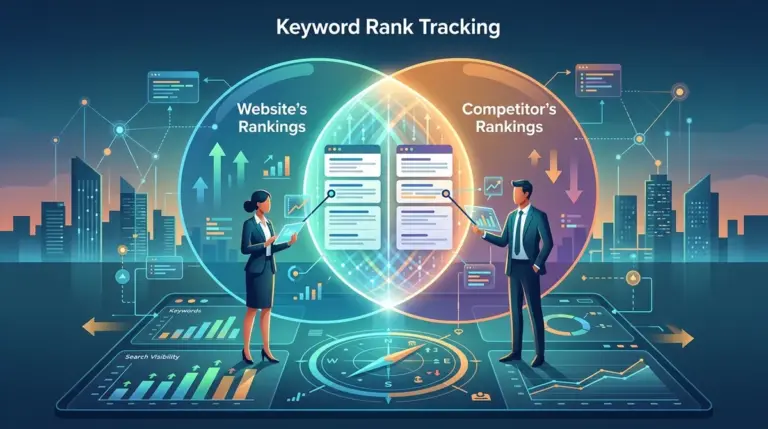


Traditional rank tracking has long been a game of observation: you watch a number go up or down and react accordingly. But as search engines integrate generative AI and more complex semantic understanding, the sheer volume of data makes manual analysis a bottleneck. To stay competitive, SEO professionals must move from monitoring positions to interpreting the underlying causes of movement. AI-driven analysis bridges this gap by identifying patterns in SERP volatility, intent shifts, and competitive maneuvers that a human eye would miss in a spreadsheet of ten thousand rows.
Automating Intent Categorization at Scale
The most immediate benefit of AI in rank tracking is the ability to classify search intent across massive datasets. Standard tools often rely on rigid keyword modifiers like "how to" or "buy" to assign intent. However, search engines frequently shift the intent of a query based on seasonal trends or user behavior changes.
AI models, specifically those utilizing Natural Language Processing (NLP), analyze the actual content of the SERP—not just the keyword string. By examining the types of pages ranking in the top 10 (e.g., listicles vs. product pages), AI can dynamically re-categorize your tracked keywords. This allows you to see if you are losing rank because your content no longer matches the search engine's current interpretation of user intent.
Best for: Enterprise-level sites managing 5,000+ keywords where manual tagging is impossible.
Detecting Rank Volatility and Algorithmic Anomalies
Raw rank data is often noisy. A three-position drop might be a temporary fluctuation, or it could be the first sign of a site-wide algorithmic penalty. AI algorithms excel at "noise reduction," distinguishing between standard daily variance and statistically significant anomalies.
By training on historical data, AI can establish a "baseline" for your specific niche. When a keyword or a cluster of keywords deviates from this baseline, the system triggers an alert. This proactive approach allows SEOs to diagnose issues—such as a broken redirect or a cannibalization problem—within hours rather than waiting for the next monthly report.
Pro Tip: Use AI-driven anomaly detection to monitor "SERP features" rather than just blue links. If your site suddenly loses a Featured Snippet but maintains position one, your click-through rate will likely plummet. AI can flag these visual changes as high-priority events.
Competitive Intelligence via Natural Language Processing
AI doesn't just track your own site; it analyzes the content of the competitors who are outranking you. By using Large Language Models (LLMs) to scrape and summarize the top-ranking pages for your target keywords, you can identify "content gaps" with mathematical precision.
- Entity Analysis: Identifying specific topics or entities that competitors mention which are missing from your page.
- Sentiment Mapping: Understanding if the top-ranking results favor a specific tone or perspective.
- Structural Comparison: Analyzing if the SERP is shifting toward video content, FAQ schemas, or interactive tools.
Instead of guessing why a competitor moved up, AI provides a list of specific semantic elements your content lacks. This turns rank tracking from a reporting task into a direct content optimization brief.
Predictive Modeling for SEO Resource Allocation
One of the hardest questions for an SEO lead to answer is: "If we move from position 8 to position 2 for this cluster, what is the actual dollar value?" AI improves keyword analysis by layering historical CTR data, seasonal search volume trends, and conversion data to create predictive models.
These models help prioritize which keywords are worth the effort. For instance, an AI analysis might reveal that while a high-volume keyword looks attractive, the SERP is so crowded with ads and "People Also Ask" boxes that even a top-three ranking would yield minimal traffic. Conversely, it might identify a "hidden gem" low-volume keyword with a clean SERP where a small boost in rank would lead to a significant increase in high-intent visitors.
Integrating AI into Your Weekly Reporting Workflow
To get the most out of AI-enhanced rank tracking, stop looking at individual keyword movements and start looking at "cluster health." Group your keywords by business value, product category, or funnel stage. Use AI to generate summaries of these clusters, identifying which segments are gaining momentum and which are decaying.
Focus your energy on the "why." If the AI flags a cluster as losing ground due to "competitor content updates," your task is to refresh your pages. If it flags "SERP layout change," you may need to pivot your strategy toward schema markup or image optimization. The goal is to spend 20% of your time identifying the problem and 80% of your time implementing the solution.
Frequently Asked Questions
How does AI differ from standard rank tracking?
Standard tracking records a position at a specific point in time. AI analysis interprets that data by comparing it against historical patterns, competitor content changes, and SERP feature shifts to explain why the rank changed and what the likely impact will be.
Do I need a data science background to use AI in SEO?
No. Most modern SEO tools are integrating these AI capabilities into their interfaces. The key is knowing how to prompt the system and how to interpret the "insights" or "anomalies" the software flags.
Can AI predict future Google algorithm updates?
Not exactly. AI cannot predict when Google will release an update, but it can detect "pre-update" volatility and identify which specific ranking factors are being weighted more heavily in real-time as an update rolls out.
Is AI intent classification 100% accurate?
While highly accurate, it is not perfect. AI intent classification should be used as a high-level filter to organize thousands of keywords. For your top 50 "money" keywords, human verification is still recommended to ensure the nuance of the content matches the user's specific needs.