

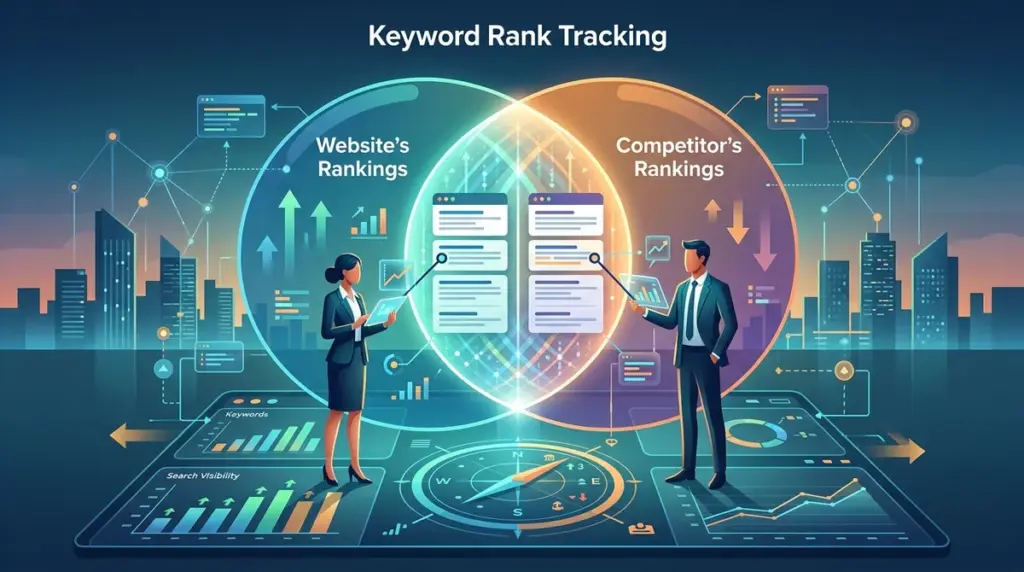
Tracking keyword overlap is the only way to determine if your SEO strategy is actually capturing market share or if you are simply ranking for terms your competitors don't value. In a crowded SERP, knowing that you rank for 1,000 keywords is meaningless unless you know how many of those terms are also occupied by your primary rivals. This data allows you to identify "content gaps" where competitors are vulnerable and "defensive zones" where you must protect high-converting traffic from aggressive poaching. This process also helps in identifying keyword gaps that can be leveraged for better ranking.
Distinguishing Between Business Rivals and SERP Competitors
Before running an overlap analysis, you must categorize who you are actually tracking. A common mistake is only tracking direct business competitors—companies that sell the same product. However, your SERP competitors are often publishers, affiliates, or aggregators that occupy the same digital real estate without selling a competing service.
Best for: Strategic planning and budget allocation.
To get an accurate overlap map, you need to monitor three distinct groups:
- Direct Competitors: Those selling the same product or service (e.g., two SaaS platforms in the CRM space).
- Informational Competitors: Media sites or blogs that rank for "how-to" and top-of-funnel queries, capturing your audience before they are ready to buy.
- Niche Disruptors: Smaller sites that dominate a specific sub-category of your keyword profile, often out-ranking you on long-tail, high-intent terms.
The Mechanics of Calculating Ranking Overlap
Ranking overlap is calculated by taking the intersection of two keyword sets. If your site ranks for 5,000 keywords and a competitor ranks for 4,000, and you share 1,500 of those keywords, your overlap is 30% of your total footprint. However, the raw number is less important than the "positional overlap."
Focus your analysis on keywords where both you and the competitor rank in the top 10. This is the "strike zone." If a competitor ranks at position 4 and you are at position 7, that specific overlap represents a direct opportunity for a traffic win through minor on-page optimizations or internal linking adjustments. By focusing on the strike zone, you can start forecasting traffic growth through strategic optimizations.
Warning: High overlap percentages are not always a sign of success. If you share 80% of your keywords with a massive industry leader, you may be trapped in a "copycat" content cycle. This often indicates you are failing to find unique content angles that provide a competitive advantage in underserved niches.
Step-by-Step Workflow for Overlap Analysis
To execute this manually or via specialized tracking software, follow this sequence to ensure the data is actionable rather than just descriptive.
1. Define the Keyword Universe
Do not attempt to track overlap across every possible keyword. Limit your analysis to a "Core Keyword List" that represents your highest-value conversion drivers. Tracking overlap on 10,000 vanity terms will dilute the data and lead to "analysis paralysis."
2. Segment by Search Intent
Overlap in "Commercial" intent keywords requires a different response than overlap in "Informational" keywords. If a competitor overlaps with you on 90% of your "Best [Product] for [Use Case]" keywords, they are directly threatening your bottom-of-funnel revenue. Use tags to segment these keywords so you can view overlap percentages by intent type.
3. Identify the "Winner" for Each Shared Term
For every overlapping keyword, determine who holds the higher position. This creates a "Win/Loss" ratio. A site with a high overlap but a low win ratio is essentially acting as a research source for the competitor who eventually wins the click at the top of the page.
Using Content Gap Analysis to Find "Low-Hanging Fruit"
The most valuable output of overlap tracking is identifying the keywords where your competitor ranks in the top 5, but you do not rank at all. This is the "Content Gap." These are proven terms—you know they are relevant because your competitor is investing in them, and you know they are reachable because a similar site is already there.
Best for: Content calendar prioritization and editorial planning.
When you find these gaps, analyze the competitor’s landing page for that term. Look for:
- Content Depth: Are they using 2,000 words while your existing (non-ranking) page only uses 500?
- Schema Markup: Are they winning rich snippets or FAQ sections that you have ignored?
- Backlink Profile: Is the specific URL powered by high-authority external links, or is it ranking purely on topical relevance?
Monitoring Overlap Volatility
Overlap is not a static metric. During core algorithm updates, you will often see overlap percentages shift dramatically. If your overlap with a major competitor drops from 50% to 20%, it doesn't necessarily mean you lost rankings; it could mean the competitor was hit by a penalty or a de-indexing event, or that Google has re-classified the intent of those keywords.
Regularly scheduled overlap reports (weekly or monthly) allow you to spot these trends before they result in a permanent loss of traffic. Sudden spikes in overlap from a new domain often signal a well-funded startup or a pivot from an existing player entering your space.
Operationalizing Your Overlap Data
Data without a workflow is overhead. Once you have identified where you overlap and where you are losing, you must categorize your response into three buckets: Protect, Attack, or Abandon.
Protect: Keywords where you rank #1 or #2 and the competitor is in positions #3-#5. These require fresh updates and monitoring of their backlink acquisition to ensure they don't leapfrog you.
Attack: Keywords where the competitor is #1 and you are #3-#10. These are the highest ROI targets for optimization. Often, improving the "Time on Page" or adding proprietary data/images can be enough to close the gap.
Abandon: Keywords where a massive authority (like Wikipedia or Amazon) holds the top spot and your overlap is at position #20+. Unless you have a specific strategic reason, these are often not worth the resource expenditure compared to "Attack" targets.
Frequently Asked Questions
How often should I check competitor overlap?
For high-competition industries, a monthly deep dive is standard. However, you should have automated alerts for any keyword in your "Top 20 Revenue Drivers" list so you know immediately if a competitor enters the top 10 for those specific terms.
Does a high overlap mean I am doing something wrong?
Not necessarily. In mature markets, high overlap is expected. It means you are targeting the right terms. The danger is when you have high overlap but a low "Average Position" compared to the competitor, which indicates their content or technical SEO is superior.
Can I track overlap for local SEO?
Yes, but the data must be geo-specific. Overlap in New York may look entirely different than overlap in Los Angeles for the same keyword set. Ensure your tracking tool uses localized IP addresses to get an accurate view of the regional SERP.
What is a "Negative Gap"?
A negative gap refers to keywords where you rank, but your competitor does not. This is your "Unique Footprint." This is where your brand has a competitive advantage, and you should analyze these terms to see if you can expand into related clusters before your competitors notice the opportunity.