
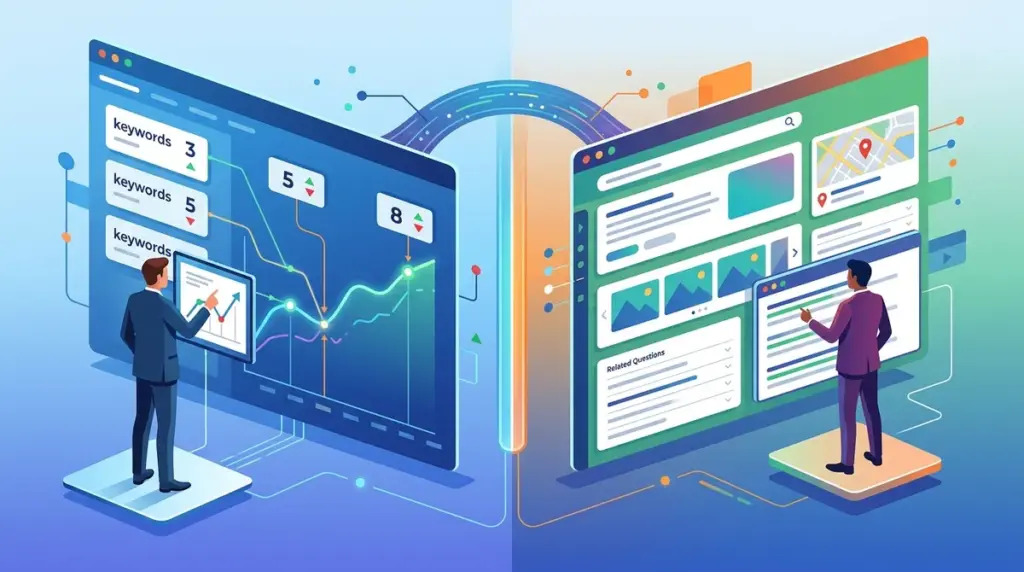
In the early days of SEO, tracking performance was a linear exercise: you chose a keyword, measured its position, and reported progress based on whether that number moved from 10 to 1. Today, that single-digit metric often fails to explain why organic traffic is dropping despite stable rankings. The discrepancy lies in the difference between keyword rank tracking and SERP tracking. While the former monitors your specific coordinates in the search index, the latter captures the entire landscape of the search engine results page, including the features that often push "Position 1" below the fold.
For an SEO professional, choosing between these two isn't about picking one over the other; it is about understanding which data point drives a specific business decision. Rank tracking provides the historical data needed for high-level reporting and stakeholder updates. SERP tracking provides the diagnostic data needed to understand why a high-ranking page isn't clicking through, or how a competitor is capturing "Position 0" through a featured snippet.
The Mechanics of Keyword Rank Tracking
Keyword rank tracking is the process of monitoring the numerical position of a website for specific search queries over time. It is a vertical measurement. If you are targeting "enterprise cloud security," a rank tracker tells you if you are at position 4, 14, or 44. This data is essential for calculating Share of Voice (SoV) and measuring the direct impact of on-page optimizations or backlink campaigns.
Best for: Reporting ROI to clients, monitoring long-term SEO health, and identifying which specific URLs are gaining or losing authority for their primary targets.
Core Data Points in Rank Tracking
Standard rank tracking focuses on three primary variables: position, search volume, and URL mapping. By aggregating these, marketers can create a "Visibility Index." This index weights your rankings against the estimated traffic of those keywords, providing a single score that represents your brand's dominance in a niche. However, rank tracking operates in a vacuum. It assumes that every "Position 1" is equal, which is increasingly untrue in a landscape dominated by paid ads and Google-owned properties.
The Contextual Depth of SERP Tracking
SERP tracking is a horizontal and environmental analysis. It doesn't just look at where you are; it looks at what else is on the page. A SERP tracker records the presence of "SERP Features"—the non-standard elements that Google uses to answer queries directly. This includes Local Packs, Image Carousels, People Also Ask (PAA) boxes, and Sponsored Shopping results.
Best for: Content strategy, conversion rate optimization (CRO), and competitive intelligence. If you rank #2 but a Featured Snippet and four Google Ads appear above you, your "real" position is effectively #6. SERP tracking identifies these visibility roadblocks.
Analyzing Pixel Height and Visual Dominance
Modern SERP tracking often utilizes "pixel height" or "above the fold" analysis. Instead of saying you are #1, a SERP tracker might tell you that your organic listing starts 850 pixels down the page. This distinction is critical for mobile SEO, where a single featured snippet can occupy the entire initial screen, rendering a traditional #1 ranking nearly invisible without a scroll. By tracking the layout, you can decide whether to fight for the organic link or pivot your strategy to capture the snippet itself.
Warning: Relying solely on numerical rank tracking can lead to "phantom traffic loss." This occurs when your rankings remain stable at position 1 or 2, but Google introduces a new SERP feature (like a massive AI Overview or a map pack) that siphons off 40% of the available clicks. Without SERP tracking, you will be unable to explain the traffic drop to stakeholders.
Key Differentiators: Granularity vs. Landscape
To build a commercially viable SEO strategy, you must distinguish between the data these two methods provide. Here is how they diverge in practice:
- Intent Identification: SERP tracking reveals intent shifts. If a SERP suddenly changes from showing blog posts to showing product grids, the intent has shifted from informational to transactional. Rank tracking won't tell you this; it will simply show your blog post dropping in rank.
- Competitor Benchmarking: Rank tracking tells you who ranks near you. SERP tracking tells you who is stealing your "real estate" via non-traditional means, such as a competitor winning the "People Also Ask" section for your primary keyword.
- Resource Allocation: Rank tracking helps you decide which pages to optimize. SERP tracking helps you decide how to optimize them—for example, by adding Schema markup to trigger a Review Snippet that increases your visual footprint.
Integrating Both Into a Commercial Strategy
The most effective SEO departments use rank tracking for the "macro" view and SERP tracking for the "micro" view. For a portfolio of 10,000 keywords, you likely only need deep SERP tracking for the top 500 "money keywords" that drive the majority of your conversions. For the remaining 9,500, standard rank tracking is sufficient to monitor for site-wide volatility or technical issues.
When a keyword shows a high search volume but a low click-through rate (CTR) despite a top-3 ranking, SERP tracking is the diagnostic tool. It may reveal that the SERP is "noisy," filled with video results or local maps that make an organic text link less appealing. In this scenario, the commercial move isn't to build more links to improve the rank; it's to produce a video or optimize the Google Business Profile to appear in those dominant features.
Building a Unified Performance Framework
To move beyond basic reporting, your framework should treat rank as a prerequisite and SERP features as the goal. Start by auditing your current keyword list to identify which terms are "feature-heavy." If a keyword triggers a Featured Snippet, your goal is no longer just "Position 1"—it is the snippet. If it triggers a Local Pack, your goal is the Map, not the blue link. This transition from tracking numbers to tracking real estate is what separates a junior SEO from a senior strategist. By monitoring the SERP environment, you gain the ability to predict traffic fluctuations before they happen, rather than reacting to them after the monthly report is generated.
Frequently Asked Questions
Does rank tracking include Google Ads?
Standard rank tracking typically ignores paid results and focuses on organic positions 1 through 100. SERP tracking, however, monitors the presence and number of ads, as they directly impact the CTR of organic results.
Can I track SERP features with a standard rank tracker?
Some basic tools only provide the numerical rank. More advanced platforms include icons or filters that show if a keyword has a snippet or image pack, but true SERP tracking allows you to see the actual historical snapshot of what that page looked like on a specific day.
Why is my rank different on mobile vs. desktop?
Google uses different algorithms and SERP layouts for mobile and desktop. SERP tracking is essential here because mobile results often prioritize local intent and shorter "snackable" content features more heavily than desktop results.
How often should I check SERP tracking data?
For high-competition keywords, daily tracking is necessary because Google frequently tests new SERP layouts. For long-tail keywords, weekly or monthly snapshots are usually enough to identify major shifts in the search landscape.