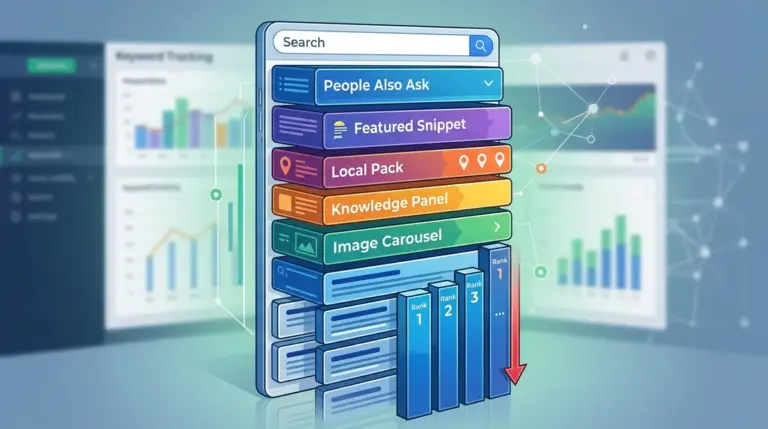


When a client calls to ask why they see their website at position five while your report shows position one, you are witnessing the friction between raw data and personalized search. For SEO professionals, "rank" is no longer a static coordinate on a universal map; it is a fluid data point influenced by a user’s physical location, search history, and device specifications. Accurate rank tracking requires moving beyond the vanity of a single number and into the mechanics of how Google assembles a unique SERP for every individual user.
The Three Pillars of Search Personalization
Google’s primary goal is relevance, which it achieves by filtering the index through several layers of user-specific data. If your tracking strategy ignores these layers, your reporting will deviate from the actual experience of your target audience.
Hyper-Local Geolocation
The most aggressive form of personalization is location-based. For "near me" queries or service-based keywords, Google uses IP addresses and GPS data to prioritize local results. Even for non-local queries, the data center serving the request can cause minor fluctuations. A user in Manhattan searching for "commercial real estate" will see a fundamentally different set of results than a user in Brooklyn, even if they are only miles apart. Tracking at the country or city level is often insufficient for businesses with physical footprints; zip-code level tracking is the only way to capture the "Map Pack" and localized organic shifts that drive actual foot traffic.
Search History and the Filter Bubble
Google tracks previous queries and clicked results to build a profile of user intent. If a user frequently visits a specific industry blog, that blog is more likely to appear higher in their future searches. This creates a "filter bubble" that can lead site owners to believe their SEO is performing better than it is. Because they visit their own site frequently, Google’s algorithms prioritize it in their personal view. Professional rank tracking must bypass this by using "clean room" environments—proxies and incognito-simulated requests—to see what a first-time visitor would see.
Device and Browser Environment
Mobile-first indexing means the mobile SERP is the primary version of the web, but desktop results still differ significantly in layout and feature density. Personalization extends to the device hardware. A search on an iPhone might prioritize different app-store links or mobile-friendly features compared to a desktop search. Furthermore, the presence of a user being logged into a Google Workspace account can trigger "Personal" results tabs, pulling in data from Gmail or Calendar, which further displaces traditional organic listings.
How Personalization Distorts Traditional Metrics
The reliance on "Average Position" as a primary KPI is becoming increasingly risky. When personalization is high, an average position of 3.4 might be composed of a #1 ranking in Chicago and a #10 ranking in Los Angeles. This obfuscates the reality of the market.
- SERP Feature Volatility: Personalization affects which SERP features appear. A user who frequently watches videos may see a Video Carousel higher up than a user who prefers long-form text.
- CTR Variance: A personalized #1 spot does not guarantee the standard click-through rate if the user is presented with a highly relevant "People Also Ask" block or a Local Pack that satisfies their intent without a click.
- Temporal Personalization: Search results can shift based on the time of day or the user's current velocity (moving in a car vs. sitting at a desk), particularly for travel and hospitality keywords.
Warning: Never rely on manual browser checks—even in Incognito mode—to verify rankings for a client. Incognito mode still utilizes your IP address and device fingerprint, meaning your "clean" search is still localized to your current city and influenced by your hardware.
Strategies for Accurate Tracking in a Fragmented SERP
To provide commercially useful data, you must isolate the variables that personalization introduces. This involves a shift from "tracking keywords" to "tracking environments."
Best for High-Intent Service Queries: Use geo-specific tracking that mimics the exact latitude and longitude of target neighborhoods. This is critical for franchises or multi-location brands where the competition changes block-by-block.
Best for National Brands: Focus on "unpersonalized" baseline tracking. By stripping away user history and location, you establish a "true north" for your SEO efforts. This allows you to measure the impact of algorithm updates and content optimizations without the noise of individual user behavior.
You must also track the "Pixel Height" of your results. Because personalization often inserts additional SERP features—like "Refine This Search" or "Related Searches"—your #1 organic ranking might actually be pushed below the fold. Measuring the distance from the top of the screen is often more indicative of traffic potential than the numerical rank itself.
Standardizing Your Performance Metrics
To counter the effects of personalization, your reporting should prioritize cohorts over individual data points. Instead of reporting a single rank for "enterprise software," report the ranking across five key metropolitan areas and two device types. This provides a matrix of performance that accounts for geographic and technical variance.
Furthermore, integrate Share of Voice (SoV) metrics. SoV calculates your visibility across a basket of keywords, accounting for the presence of ads and SERP features. This metric is more resilient to personalization because it looks at the total brand footprint rather than a single user's experience. When personalization makes the SERP unpredictable, the goal is to ensure your brand is the most consistent presence across the widest possible variety of personalized views.
Frequently Asked Questions
Does Google search history affect my site's actual ranking in search consoles?
No. Tools like Google Search Console report on "average position" based on actual impressions served to users. While an individual user might see you at #1 due to their history, the Search Console data aggregates all users, providing a more objective view of your standing across the entire search population.
Is it possible to track rankings for users who are logged into Google?
Generally, no. Rank tracking tools simulate "logged-out" users to provide a neutral baseline. Tracking "logged-in" results would require access to private user data, which is neither ethical nor scalable. The industry standard is to track the "clean" SERP that greets new or anonymous users.
How often should I track localized rankings?
For highly competitive local niches (lawyers, locksmiths, HVAC), daily tracking is necessary because the Local Pack can fluctuate based on the time of day and competitor proximity. For national B2B keywords, weekly tracking is usually sufficient to identify trends without getting lost in the daily "noise" of personalization shifts.
Can personalization be "turned off" for more accurate SEO testing?
You can use parameters like &pws=0 in a Google search URL to disable personalized web search, but this is a legacy fix. Modern SEO requires accepting that there is no "default" SERP. The most accurate approach is to use a dedicated tracking platform that queries Google from specific data centers and locations to simulate different user profiles.