

SEO reporting often prioritizes rank position as the ultimate KPI, yet many site owners find themselves in a frustrating paradox: their primary keywords have climbed into the top three, but organic traffic remains stagnant or even declines. This disconnect occurs because a ranking is merely a measure of visibility, not an invitation to engage. In a modern search environment, the distance between a high position and a click has widened due to layout shifts, user behavior changes, and intent misalignment.
Understanding why rankings fail to convert into clicks requires moving beyond the "position equals traffic" mindset. It involves analyzing the specific anatomy of the Search Engine Results Page (SERP) and recognizing that Google now serves many users directly on the results page, effectively bypassing the need for a website visit.
The Rise of Zero-Click Searches and SERP Crowding
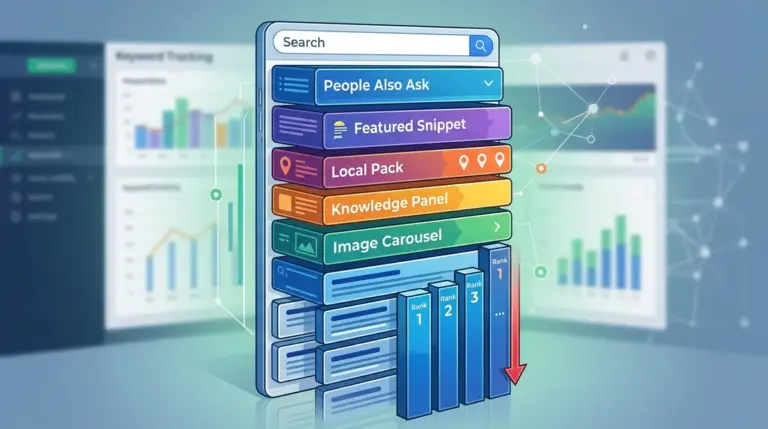
The most immediate reason for a traffic-rank mismatch is the proliferation of SERP features that satisfy user intent without a click. When Google provides a Featured Snippet, an AI Overview, or a Knowledge Panel, the user often finds the answer they need immediately. This is particularly prevalent for "What is" or "How to" queries where the information is factual and concise.
Pixel Depth and the Fold: Even a #1 organic ranking can be pushed "below the fold" on mobile devices. If a SERP contains four sponsored ads, a Local Pack, and an AI-generated summary, the first organic result might not appear until the user has scrolled significantly. In these instances, you technically hold the top spot, but your "visual share of voice" is minimal compared to the paid and automated elements above you.
- Sponsored Dominance: High-intent commercial keywords are often crowded by four ads at the top and three at the bottom, squeezing organic results.
- Local Packs: For queries with local intent, the "Map Pack" captures the vast majority of mobile clicks, leaving organic listings to fight for the remaining scraps.
- People Also Ask (PAA): These accordions break up the organic flow and can distract users, leading them down a rabbit hole of internal Google queries rather than clicking through to a site.
Misalignment Between Content Type and Search Intent
Rankings often improve for keywords where the page content does not perfectly match what the user is looking for at that moment. Google's algorithm may recognize your page as authoritative and relevant enough to rank it, but users may find it irrelevant to their specific stage in the buyer's journey.
For example, if a user searches for "best project management software," they are likely looking for a comparison list or a third-party review site. If your product landing page ranks #2 for this term, your CTR will likely be lower than the #5 result that offers a comprehensive comparison of ten different tools. The user wants to research, not be sold to immediately. Conversely, ranking an informational blog post for a transactional query like "buy enterprise CRM" will result in high impressions but low clicks, as the user is ready to purchase, not read a 2,000-word guide on CRM history.
Pro Tip: Use Search Console to compare the "Average Position" against the "CTR" for specific URLs. If a page ranks in the top 3 but has a CTR below 3%, your meta title likely lacks a "hook" or your content type is mismatched with the dominant intent of that SERP.
The Impact of Weak Meta Optimization
A high ranking gets you on the shelf, but your meta title and description are what sell the click. If your competitors have invested in compelling, benefit-driven copy while you have relied on automated or keyword-stuffed titles, they will win the click even from a lower position. Modern searchers are savvy; they look for clues that a page will actually solve their problem.
Common CTR Killers:
1. Truncated Titles: Titles over 60 characters get cut off, often hiding the most important value proposition.
2. Vague Descriptions: Meta descriptions that fail to summarize the page or include a call to action.
3. Lack of Schema: Missing out on review stars, price points, or FAQ schema makes your listing look "flat" compared to enriched results.
Brand Authority and Trust Signals
In many industries, users will bypass the #1 result to click on a brand they recognize at #3 or #4. This "brand bias" is a significant factor in CTR. If you are ranking for a high-competition term alongside household names or industry leaders, your organic position may not be enough to overcome the trust gap. Users perceive established brands as safer or more authoritative sources of information, especially in YMYL (Your Money, Your Life) niches like finance or healthcare.
Seasonality and Keyword Volume Fluctuations
Sometimes, ranking improvements coincide with a natural dip in search volume. If you move from position 5 to position 1 for "winter coats" in April, your clicks will inevitably drop despite the better ranking. This isn't a failure of SEO strategy, but a reality of market demand. Marketers must distinguish between "ranking growth" and "market opportunity." Ranking #1 for a keyword that has lost 80% of its monthly volume will never result in a traffic surge.
Additionally, "keyword cannibalization" can mask true performance. If two of your pages are fighting for the same keyword, Google may flip-flop between them. You might see a "ranking improvement" as one page moves up, but if the overall click-through rate is split between two mediocre results instead of one strong result, your total traffic will suffer.
Aligning Rank Strategy with Traffic Reality
To ensure that ranking gains translate into actual business value, shift your focus from raw position to "Qualified Traffic Potential." This requires a more nuanced approach to keyword selection and SERP analysis. Stop chasing high-volume keywords where the SERP is dominated by zero-click features or massive brand competitors unless you have a specific strategy to displace them.
Perform a manual audit of the SERPs for your top 20 target keywords. If you see that the top half of the screen is entirely occupied by Google-owned features, consider pivoting your strategy toward "long-tail" queries. These often have less competition, clearer intent, and fewer SERP distractions, leading to a much higher CTR despite lower raw search volume. Furthermore, invest time in A/B testing your meta titles. Even a 1% increase in CTR on a high-ranking page can result in thousands of additional visitors without needing to move up a single spot in the rankings.
Frequently Asked Questions
Why is my CTR lower than the industry average for a #1 ranking?
Industry averages are often skewed by brand-name searches. If your keyword is a generic term (e.g., "insurance"), a #1 spot might only net a 15-20% CTR because of heavy ad presence and diverse user intent. If your CTR is exceptionally low, check for "Searcher Task Accomplishment" features like AI Overviews that may be answering the question on-page.
Can I recover clicks lost to AI Overviews?
You cannot "turn off" AI Overviews, but you can optimize to be the source cited within them. Focus on providing clear, structured data and concise answers to specific questions within your content. If Google uses your site as a reference in the AI summary, you may see a different type of high-intent traffic, though overall click volume for the keyword may still decrease.
How do I know if my ranking is "vanity" or "valuable"?
A ranking is valuable if it leads to a conversion or a meaningful interaction. If you rank #1 for a term but the "Bounce Rate" is 95% and "Time on Page" is 10 seconds, the ranking is a vanity metric. It means you are attracting the wrong audience or failing to meet the expectations set by your SERP listing.
Does ranking for "People Also Ask" help my traffic?
Ranking in PAA boxes increases brand visibility but often results in lower click-through rates than a traditional organic listing. However, appearing in PAA can prevent competitors from capturing that space and helps establish your site as a topical authority, which can indirectly boost the rankings of your primary pages.