

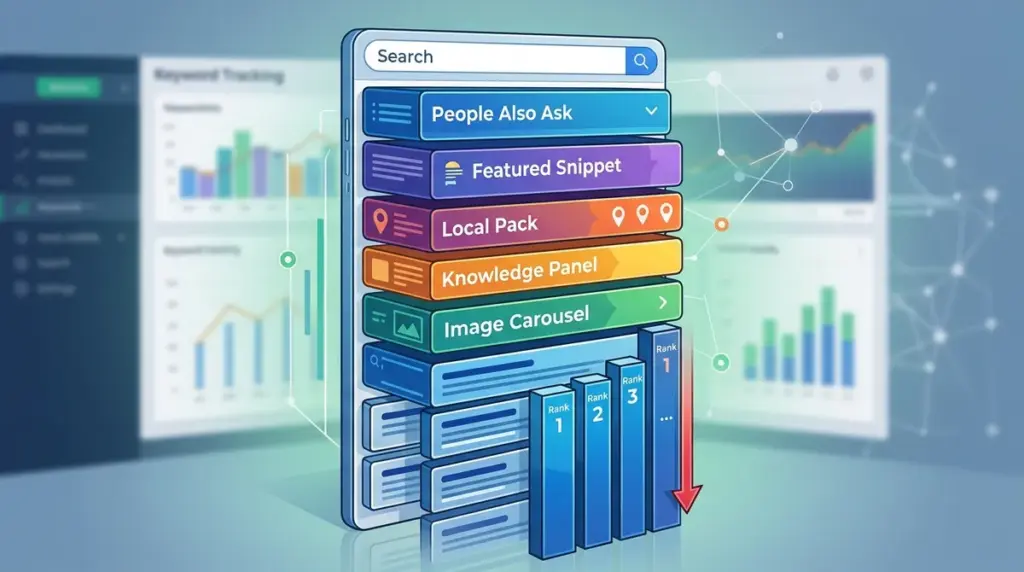
The traditional concept of ranking #1 is undergoing a fundamental devaluation. In a landscape dominated by Google’s own assets, a top-tier organic position no longer guarantees the lion’s share of traffic. Search Engine Results Page (SERP) features—ranging from Featured Snippets and "People Also Ask" (PAA) boxes to Local Packs and AI Overviews—act as visual barriers that push organic listings further down the page, often below the initial fold. For SEO professionals, this means that tracking numerical rank is insufficient; you must track pixel depth and visibility share to understand the commercial reality of your keywords.
The Pixel-Depth Problem: Why Rank #1 Is Often Rank #4
When a user performs a search, the "above the fold" area is the most valuable real estate on the internet. Historically, the first organic result occupied this space. Today, a high-intent commercial query typically triggers a stack of features that can push the first organic link 600 to 1,000 pixels down the page. On mobile devices, this often requires two full swipes before the user sees a non-sponsored, non-feature link.
Impact on CTR: Data across millions of queries shows that when a Featured Snippet is present, the CTR for the #1 organic result can drop by as much as 10% to 15%. This is because the snippet provides the answer directly on the SERP, facilitating a "zero-click" search where the user’s intent is satisfied without them ever visiting a third-party website.
Featured Snippets as Intent Killers
Featured Snippets occupy "Position Zero." While they are technically pulled from organic content, they serve a dual purpose: they provide immediate utility to the user and they act as a ceiling for all other organic results. If your content is the source of the snippet, you gain visibility but may lose session duration. If your competitor holds the snippet, your #1 rank is effectively relegated to the second visual tier.
The People Also Ask (PAA) Expansion
PAA boxes are particularly disruptive because they are dynamic. Every time a user clicks a question in the PAA accordion, the list expands, pushing organic results even further down the page in real-time. This creates a moving target for organic visibility. For informational queries, a large PAA block can occupy more vertical space than the top three organic results combined.
Visual Real Estate and the Rise of Vertical Search Features
Google is increasingly moving toward a "walled garden" approach for specific categories of intent. By integrating its own vertical search products directly into the main SERP, it displaces traditional web listings in favor of structured data modules.
- Local Packs: For any query with local intent (e.g., "HVAC repair near me"), the Local 3-Pack and map interface take precedence. Organic listings for even the most authoritative sites are pushed to the bottom of the first page.
- Image and Video Carousels: For visual or instructional queries, Google inserts horizontal carousels. These break the vertical flow of text-based results and draw the eye away from organic meta descriptions.
- Sponsored Shopping Tiles: In e-commerce, the top of the SERP is frequently a grid of product images. This visual dominance makes the first organic text link appear secondary and less trustworthy to a casual shopper.
Warning: Relying solely on "Average Position" in your reporting can hide a catastrophic loss in traffic. If your average position remains 2.1 but Google introduces a Local Pack and a Shopping carousel for your primary keywords, your actual visibility has likely decreased by over 50%.
Measuring True Visibility Beyond Numerical Rank
To combat the displacement caused by SERP features, agencies and in-house teams must shift their KPIs. Numerical rank is a vanity metric if it exists in a vacuum. Instead, focus on the following metrics to gauge true performance:
Visibility Share: This calculation weighs your rank against the presence of SERP features. A rank of #1 on a clean SERP is worth 100% of the available organic visibility, whereas a rank of #1 behind a Featured Snippet and a PAA box might only be worth 40%.
Pixel Height to Result: This measures the actual distance from the top of the browser window to your listing. This is the most accurate way to determine if your content is actually being seen "above the fold." If your pixel height exceeds 800px on desktop or 500px on mobile, you are effectively invisible to a significant portion of users.
The Impact of AI Overviews (SGE)
The introduction of AI-generated overviews represents the most significant shift in SERP layout in a decade. These overviews occupy the most prominent space at the top of the page, synthesizing information from multiple sources. For many users, the AI Overview is the final destination. This forces SEOs to pivot from "ranking for clicks" to "ranking for inclusion" within the AI’s source citations, which often follow different algorithmic rules than standard organic search.
Strategies to Reclaim Real Estate
You cannot stop Google from adding features, but you can optimize to occupy them. If you cannot beat the feature, you must become the feature.
Targeting the Snippet: Use concise, "definition-style" paragraphs (40-60 words) for informational queries. Use H2 and H3 tags that mirror the questions found in PAA boxes to signal relevance to Google’s snippet extractor.
Schema Markup Implementation: Use FAQ, Product, and Review schema to expand the footprint of your organic listing. While this doesn't move you higher, it makes your listing "taller," helping it compete visually with other SERP features.
Local and Video Integration: If your keywords trigger Local Packs or Video Carousels, you must produce content for those specific formats. This means optimizing Google Business Profiles and creating YouTube content that is indexed as a "Key Moment" in the SERP.
Audit Your SERP Landscape
To protect your organic traffic, you must perform a SERP feature audit for your highest-value keyword clusters. Do not just look at who is ranking; look at what is occupying the top 1,000 pixels. If a keyword is heavily saturated with ads, snippets, and PAA boxes, it may be more cost-effective to pivot your content strategy toward long-tail queries with "cleaner" SERPs where organic results still dominate the fold. Success in modern SEO is no longer about being #1; it is about being the most visible entity on the screen, regardless of the format.
Frequently Asked Questions
How can I see if SERP features are affecting my traffic?
Compare your Google Search Console (GSC) click-through rates for specific keywords against historical benchmarks. If your position remains stable but your CTR is declining, it is almost certain that a new SERP feature or an expanded ad block has been introduced for that query.
Can I opt out of being featured in snippets?
Yes, you can use the nosnippet meta tag to prevent Google from showing a snippet of your page. However, this is generally discouraged for most sites, as it simply allows a competitor to take that space, further pushing your result down the page without any visibility benefit.
Do SERP features affect mobile and desktop differently?
Yes. Mobile SERPs are significantly more impacted by features due to the limited screen width. A single PAA box or a Local Pack can occupy the entire initial screen on a smartphone, making organic results invisible until the user scrolls. Desktop users have more visual "breathing room," but the trend toward feature-heavy layouts is narrowing this gap.