

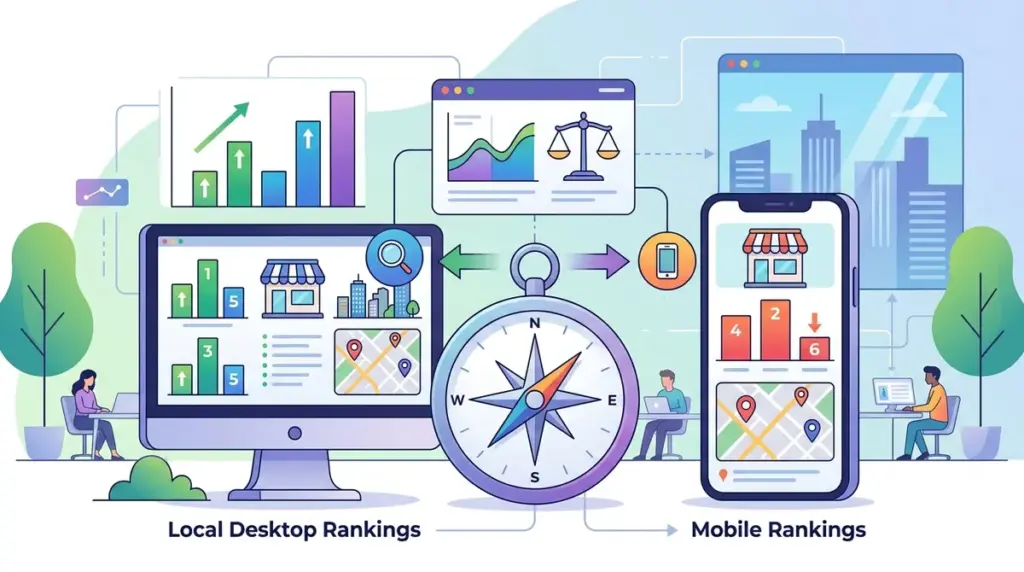
The assumption that a keyword ranking at position three on a desktop browser will hold that same value on a smartphone is a common strategic error. Google maintains distinct algorithms and indexing priorities for mobile and desktop environments, particularly when local intent is involved. For service-area businesses and brick-and-mortar retailers, the "local pack" and organic results shift based on the user's precise GPS coordinates versus a more generalized IP-based location. Comparing these datasets is not just an academic exercise; it is the only way to identify where your mobile site speed is costing you visibility or where your desktop content is failing to satisfy local search intent.
The Technical Divergence Between Desktop and Mobile SERPs
Mobile search results are heavily influenced by the "Mobile-First Index," which prioritizes the mobile version of a site’s content for indexing and ranking. However, the most significant variance in local search comes from proximity. A desktop user in an office is often geolocated via their Internet Service Provider (ISP), which might place them several miles away from their actual desk. Conversely, a mobile user has GPS enabled, providing Google with hyper-accurate coordinates. This accuracy triggers the "Near Me" algorithm more aggressively, often shrinking the "radius of relevance" for mobile searches compared to desktop.
Best for: Multi-location brands and local SEO agencies that need to justify mobile-specific UX investments to stakeholders.
Beyond proximity, screen real estate dictates how many organic results a user sees before they stop scrolling. On desktop, the local pack often appears alongside or just below the first few organic results. On mobile, the local pack—accompanied by "Call" and "Directions" buttons—can occupy the entire first two screens of results. If your desktop organic rank is high but your mobile local pack presence is non-existent, your mobile traffic will plummet despite "good" traditional rankings.
Establishing a Comparative Tracking Framework
To accurately compare these two environments, you must eliminate variables. You cannot compare a mobile search in one neighborhood to a desktop search in another. You need a synchronized tracking setup that monitors the same keywords across both device types at the exact same location coordinates.
- Coordinate-Level Tracking: Set your tracking parameters to specific zip codes or latitudinal/longitudinal points rather than just "City Level."
- Device Segmentation: Tag your keywords in your tracking dashboard as [Keyword] - Mobile and [Keyword] - Desktop.
- SERP Feature Monitoring: Track the presence of the Local Pack, Image Carousels, and "People Also Ask" blocks, as these appear in different orders depending on the device.
Warning: Avoid relying on "National" or "State-level" tracking for local keywords. Google’s local algorithm is hyper-sensitive; a ranking can fluctuate significantly between two zip codes in the same city. Tracking at too broad a level provides "blended" data that masks local performance failures.
Analyzing the Delta: Why Rankings Shift
When you see a significant gap—for example, ranking #2 on desktop but #12 on mobile—the cause is usually technical or related to the Google Business Profile (GBP). If the organic mobile rank is low but the desktop rank is high, the primary culprit is often Core Web Vitals. Google’s mobile algorithm penalizes slow-loading pages more heavily because mobile users are often on constrained networks.
If the discrepancy exists within the Local Pack specifically, check your GBP optimization. Mobile users are more likely to interact with "Open Now" filters and click-to-call features. If your business hours are missing or your phone number isn't formatted as a clickable link on your mobile site, Google may deprioritize your listing in mobile-specific local results to favor a more "mobile-friendly" competitor.
Commercial Implications of the Ranking Gap
The intent behind a desktop search is often research-oriented, while mobile search is transactional and immediate. A user searching for "plumber" on a desktop at 2:00 PM might be looking for quotes for a renovation. A user searching for "plumber" on a mobile device at 2:00 PM likely has a leak. If you are winning on desktop but losing on mobile, you are capturing researchers but missing out on high-intent, immediate-conversion customers.
Best for: E-commerce sites with physical storefronts that need to balance "Top of Funnel" information with "Bottom of Funnel" local conversions.
By comparing the click-through rate (CTR) data from Search Console against your ranking data, you can see the "real-world" impact of these shifts. A position #3 on mobile often yields a higher CTR for local services than position #1 on desktop, simply because the mobile interface encourages immediate action through integrated map features.
Auditing Your Local Visibility Strategy
To bridge the gap between desktop and mobile performance, execute a targeted audit based on your comparative data. If mobile is lagging, start with a mobile-specific crawl of your site to identify render-blocking resources. Ensure that your NAP (Name, Address, Phone Number) data is not just present, but coded in Keyword Rank Tracking markup so Google can easily associate your web content with your physical location coordinates across all devices.
Check the "Prominence" factor of your local SEO. This includes the frequency and velocity of mobile-uploaded reviews and photos. Google tracks user behavior; if mobile users frequently "Request Directions" to your competitor but only "Visit Website" on yours via desktop, the algorithm will eventually favor the competitor for mobile-intent queries. Align your mobile landing pages to be "thumb-friendly" with clear CTAs that mirror the urgency of a local mobile search.
Frequently Asked Questions
Why is my local pack ranking different on mobile than on desktop?
Mobile rankings rely heavily on GPS data and proximity, whereas desktop rankings often use ISP-based location data. Additionally, mobile-specific factors like page load speed and mobile-friendly UI influence the mobile algorithm more than the desktop version.
How often should I compare desktop and mobile rankings?
For high-competition local keywords, a weekly comparison is necessary. Local SERPs are volatile and can change based on new reviews, competitor updates to Google Business Profiles, or shifts in Google’s proximity weighting.
Does a high desktop rank help my mobile rank?
While the authority of your domain (backlinks, content quality) carries over to both devices, it does not guarantee mobile success. You must still meet mobile-specific criteria, such as passing Core Web Vitals and having a responsive design, to maintain those rankings on smartphones.
Can I track local rankings without being physically in that location?
Yes, professional rank tracking tools allow you to spoof your location using specific coordinates or zip codes. This is essential for agencies managing clients in different geographic regions to see exactly what a local user sees on their device.