

Local SEO reporting is a high-stakes transparency exercise. Unlike national campaigns where a single ranking position often suffices, local performance is dictated by proximity, making a single "rank" for a city-wide keyword functionally useless. If an agency reports a #1 ranking for "emergency plumber" without specifying the searcher's exact coordinates, they are likely misrepresenting the data. Clients do not care about theoretical rankings; they care about the phone calls and foot traffic generated within a specific three-to-five-mile radius of their physical storefront.
Visualizing Proximity with Grid Tracking
Traditional rank tracking provides a flat view of performance. For local clients, you must transition to grid-based reporting. This involves tracking a single keyword across a 3x3, 5x5, or 7x7 grid of geo-coordinates centered on the client's business location. This visualization proves to the client exactly where their visibility "drops off" and where competitors are encroaching on their territory.
Best for: Multi-location brands and service-area businesses (SABs) that need to see how far their "ranking bubble" extends before it is pierced by a competitor closer to the searcher.
When reporting grid data, focus on the Average Map Rank (AMR). If a client ranks #1 at their front door but #12 three blocks away, their AMR will reveal the true health of their local presence. Use these maps to justify local link-building or the creation of location-specific landing pages for surrounding suburbs.
Segregating Map Pack from Organic Results
Clients often conflate the Google Map Pack (Local Pack) with the localized organic results appearing below it. Your reports must explicitly separate these two datasets. A business may dominate the Map Pack due to proximity and review count but fail to appear on the first page of organic results because their website lacks technical authority.
- Map Pack Metrics: Focus on the "Local 3-Pack" presence. Report on the percentage of tracked keywords where the client appears in the top 3.
- Localized Organic Metrics: Track the "Blue Link" rankings. These are influenced more by traditional SEO factors like on-page optimization and backlink profiles.
- SERP Feature Volatility: Document when Google removes or adds the Map Pack for specific queries, as this explains sudden shifts in traffic that are outside of your control.
Pro Tip: Always cross-reference ranking spikes with "Google Business Profile" updates. If rankings jump after you added new high-resolution photos or responded to ten reviews, highlight this correlation to the client. It reinforces the value of active profile management over passive technical SEO.
Integrating Google Business Profile Action Data
Rankings are a leading indicator, but "actions" are the lagging indicator that proves ROI. A local report is incomplete without data pulled directly from the Google Business Profile (GBP) API. You must bridge the gap between "we are ranking higher" and "you are getting more customers."
Focus on three specific action types: Phone Calls, Direction Requests, and Website Clicks. When reporting these, distinguish between "Direct" searches (customers looking for the brand name) and "Discovery" searches (customers looking for a category like "pizza near me"). Growth in Discovery searches is the most accurate metric for measuring the success of a local SEO campaign, as it represents new customer acquisition rather than brand retention.
Reporting Search Intent Shifts
Not all local keywords are equal. A client ranking for "how to fix a leaky faucet" (Informational) is less valuable than one ranking for "plumber near me" (Transactional). Your reports should categorize keywords by intent. This prevents the client from becoming over-excited by high-volume, low-conversion rankings while ignoring the high-intent keywords that actually drive their revenue.
Benchmarking Against Hyper-Local Competitors
Local SEO is a zero-sum game. If your client moves up, someone else moves down. Your reporting should include a "Share of Voice" or "Local Visibility Index" that compares the client against their top three physical competitors. This is not about national brands; it is about the shop two blocks away.
Identify which competitors are consistently appearing in the Map Pack for the client’s primary keywords. Analyze their review velocity and average rating compared to your client. If a competitor is outranking your client despite having fewer reviews, use your report to point out their superior local citations or better-optimized GBP categories. This provides a concrete roadmap for the next month’s deliverables.
Establishing a Commercial Reporting Cadence
The frequency of local reporting should match the client's business cycle. For high-volume retail or seasonal services, weekly snapshots are necessary to catch "Map Pack" volatility. For professional services like law firms or accountants, a monthly deep dive is more appropriate to filter out the "noise" of daily ranking fluctuations.
Avoid "data dumping." A 40-page report of every keyword variation will be ignored. Instead, curate the report to show:
1. Progress on "Hero" keywords (the top 5 revenue drivers).
2. GBP Action trends compared to the previous year (to account for seasonality).
3. A summary of "Work Completed" vs. "Impact Observed."
Refining the Local Performance Narrative
To deliver a report that retains clients, you must move beyond the spreadsheet. Start your report with a high-level executive summary that answers one question: "Did we win more of the neighborhood this month?" Use the grid tracking data to show the expanding radius of influence and the GBP action data to prove that this visibility resulted in tangible leads. By connecting the dots between proximity, rankings, and actions, you transform a technical SEO report into a vital business intelligence document that justifies your agency's monthly retainer.
Local Reporting FAQ
How do I handle "ranking drops" caused by Google's proximity filter?
Explain to the client that Google prioritizes the searcher's current location. If a searcher moves further away from the business, the ranking will naturally drop. This is why grid tracking is essential; it shows that while the business might be "down" in a distant neighborhood, it remains dominant in its core service area.
Should I report on third-party citations like Yelp or Yellow Pages?
Yes, but only in the context of "referral traffic" and "NAP consistency." While citations are a foundational local SEO tactic, their direct impact on rankings has diminished. Report on them as a "health check" rather than a primary performance metric.
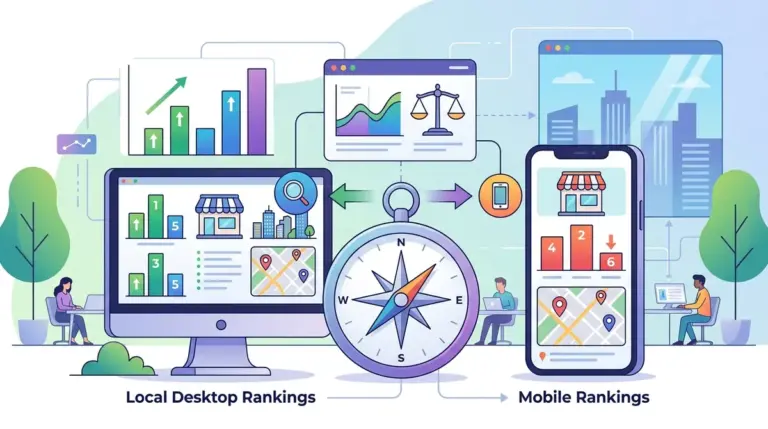
Why does my rank tracker show #1, but the client sees #5 on their phone?
This is the "Personalization Gap." Google tailors results based on search history, device type, and precise GPS data. Always instruct clients to use "Incognito" mode or, better yet, rely on the geo-coded snapshots provided in your professional reporting tool to see an unbiased view of the SERP.
What is the most important local SEO metric for a new business?
For a new business, "Discovery Search" volume is the most critical metric. It indicates that the business is appearing for category-based searches before it has established significant brand recognition in the community.