
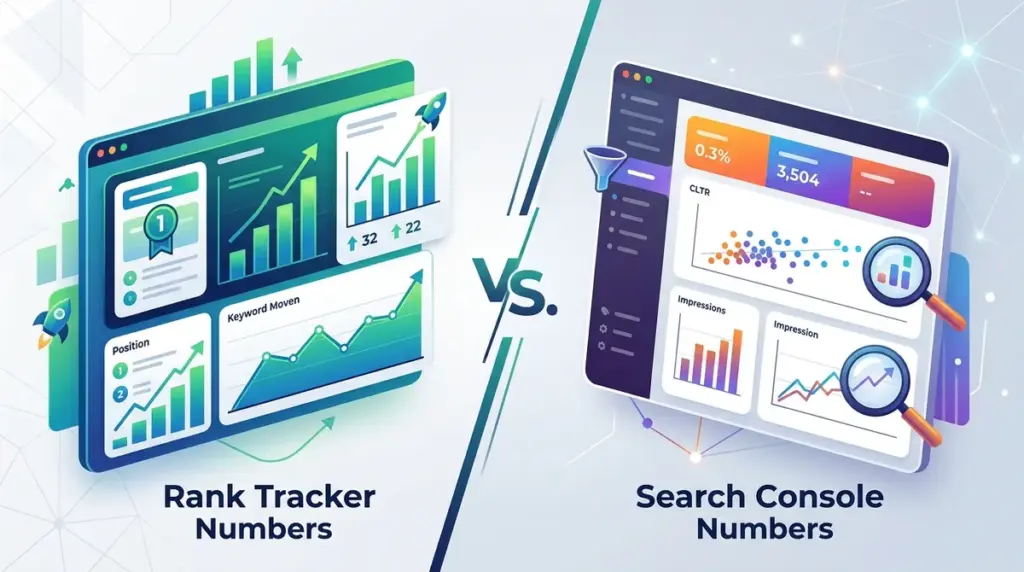
Discrepancies between Google Search Console (GSC) and third-party rank tracking software are not errors; they are the result of two fundamentally different methodologies for measuring the web. If you are reporting to a client or a stakeholder, explaining that "the data is just different" rarely suffices. You need to understand the technical mechanics of how Google logs an impression versus how a rank tracker fetches a SERP snapshot.
Google Search Console provides a retrospective view based on actual user behavior. Rank trackers provide a prospective, controlled view based on simulated requests. This distinction creates a gap in data that often leads to confusion when a tracker shows a keyword at position #3 while GSC reports an average position of #8.4. To manage SEO performance effectively, you must treat GSC as a record of historical reality and your rank tracker as a high-frequency diagnostic tool.
The Log vs. The Snapshot
The primary reason for the data gap is the source of the information. Google Search Console is server-side data. When a user performs a search and your URL appears in the results, Google logs that event. If the user is in Chicago, searching on an iPhone, and sees your site at position #4, that specific data point is recorded. GSC then aggregates millions of these unique instances to provide an "Average Position."
In contrast, a rank tracker performs client-side emulation. It sends a request to Google’s servers from a specific IP address, using a specific user-agent (like a Chrome mobile browser), and records what the SERP looks like at that exact millisecond. It is a "clean room" environment designed to strip away the noise of individual user history to show you where you stand in a vacuum. Because the tracker is not recording every single user interaction across the globe, it cannot account for the infinite variations in local search results that GSC captures.
The Math of the Average Position
GSC’s "Average Position" is a calculation that often flattens the peaks and valleys of your actual performance. If your site ranks #1 for 500 users in New York but ranks #40 for 500 users in Los Angeles, GSC will report an average position of #20.5. A rank tracker, depending on its configured location, will likely show you either #1 or #40, but rarely the average of #20.5.
Impression Thresholds and Data Sampling
Google does not report every single impression. To protect user privacy and manage data loads, GSC filters out "very rare" queries (long-tail keywords with extremely low volume) and may sample data in high-volume accounts. Furthermore, GSC only records a position if an impression occurs. If your site is on page 2 and no one clicks to page 2, Google may not record a position for that specific search instance, whereas a rank tracker will diligently crawl through the pages to find your exact placement.
Warning: Relying solely on GSC for "real-time" tracking during a site migration or a core algorithm update is dangerous. GSC data is typically delayed by 48 to 72 hours, meaning the "current" position you see is actually a reflection of the SERP from three days ago.
Localization and Personalization Variables
Google’s search results are hyper-localized. Factors such as the user’s GPS coordinates, search history, and even whether they are logged into a Google account influence the SERP layout. GSC captures the aggregate of all these personalized experiences.
Rank trackers attempt to minimize this variability to provide a baseline. Most professional trackers allow you to specify a zip code or city to see localized results, but they generally cannot replicate the "search history" component of a real human user. This is why a tracker might show you a "stable" rank while GSC shows a fluctuating average; GSC is capturing the volatility of user-specific results that the tracker is intentionally ignoring.
SERP Feature Displacement
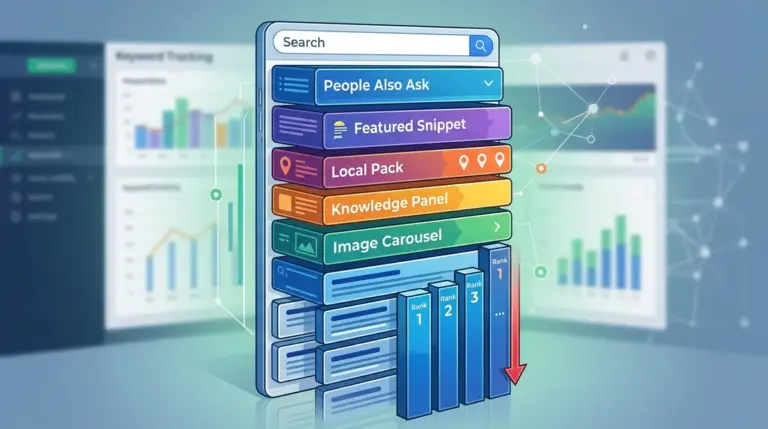
How a tool counts "Position 1" varies significantly. In GSC, the topmost link in the search results is usually position 1. However, the presence of SERP features can complicate this:
- Knowledge Panels: GSC generally assigns these the top position, even if they aren't a traditional blue link.
- Map Packs (Local Pack): GSC counts impressions for the local pack, but the positioning logic can vary depending on whether the user clicked the map or the list.
- Featured Snippets: These are almost always recorded as position 1 in both GSC and trackers, but the "People Also Ask" (PAA) boxes can shift the count of the organic links below them.
Many rank trackers allow you to toggle whether SERP features should be included in the ranking count. If your tracker is set to "Ignore Local Packs" but GSC is counting them, your numbers will never align.
Temporal Mismatch and Data Latency
The time-of-day factor is often overlooked. Google updates its index and reorders SERPs constantly throughout a 24-hour cycle. A rank tracker might be set to "Daily Update" at 4:00 AM EST. If a major competitor launches a piece of content at 10:00 AM that pushes you down, your tracker won't show that change until the next day. GSC, however, will aggregate all the impressions from both before and after that competitor’s launch, resulting in a daily average that doesn't match either the "before" or "after" snapshot of your tracker.
Aligning Your Reporting Strategy
Instead of trying to force these two data sets to match, use them for their intended strengths. GSC is the ultimate source of truth for user intent and traffic volume. It tells you what people are actually seeing and clicking on. It is an "outcomes" tool.
A rank tracker is a competitive intelligence and technical diagnostic tool. It tells you how Google’s algorithm views your site relative to your competitors in a controlled environment. Use the rank tracker to monitor the immediate impact of on-page changes, track your share of voice against specific rivals, and get alerted to sudden drops that GSC won't report for several days.
When presenting data to clients, lead with the rank tracker for "Visibility Trends" and use Search Console for "Actual Performance." This distinction clarifies that while the rank tracker shows the potential of the site's positioning, GSC shows the reality of how users are interacting with those positions.
Common Questions Regarding Data Discrepancy
Why does GSC show a rank for a keyword that my tracker says I don't rank for?
This usually happens because GSC captures "accidental" rankings or long-tail variations that a rank tracker isn't monitoring. It can also occur if you rank in a specific geographic region that your tracker isn't configured to check.
Which data source is more accurate for SEO ROI?
Search Console is more accurate for ROI because it ties positions to actual clicks and impressions. A rank tracker shows you where you could get traffic, but GSC shows you where you are getting traffic.
Can I use GSC to track daily ranking volatility?
No. Because GSC provides an average over a 24-hour period (and is delayed by several days), it masks intra-day volatility. A rank tracker that fetches data multiple times a day or at a specific fixed time is necessary for monitoring algorithm updates or technical issues.
Does the "Desktop vs. Mobile" filter affect the discrepancy?
Significantly. Google uses mobile-first indexing, but the SERPs for desktop and mobile are still distinct. If your rank tracker is checking desktop results but your GSC view is unfiltered, the high volume of mobile traffic will skew the GSC average away from your tracker's desktop-only data.